
非官方中文翻译
本页译自 MNE-Python 官方文档:
查看英文原文 ↗。
文档版权归 MNE Developers 所有(BSD-3-Clause)。
说明
转到末尾下载完整示例代码。
用噪声协方差白化诱发数据#
加载诱发数据,然后用给定的噪声协方差矩阵做白化。这是很好的质量检查,可判断基线期信号是否符合高斯白噪声假设。
协方差估计与诊断图基于 [1]。
参考文献#
# Authors: Alexandre Gramfort <alexandre.gramfort@inria.fr>
#          Denis A. Engemann <denis.engemann@gmail.com>
#
# License: BSD-3-Clause
# Copyright the MNE-Python contributors.
import mne
from mne import io
from mne.cov import compute_covariance
from mne.datasets import sample

print(__doc__)
设置参数
data_path = sample.data_path()
meg_path = data_path / "MEG" / "sample"
raw_fname = meg_path / "sample_audvis_filt-0-40_raw.fif"
event_fname = meg_path / "sample_audvis_filt-0-40_raw-eve.fif"

raw = io.read_raw_fif(raw_fname, preload=True)
raw.filter(1, 40, fir_design="firwin")
raw.info["bads"] += ["MEG 2443"]  # bads + 1 more
events = mne.read_events(event_fname)

# let's look at rare events, button presses
event_id, tmin, tmax = 2, -0.2, 0.5
reject = dict(mag=4e-12, grad=4000e-13, eeg=80e-6)

epochs = mne.Epochs(
    raw,
    events,
    event_id,
    tmin,
    tmax,
    picks=("meg", "eeg"),
    baseline=None,
    reject=reject,
    preload=True,
)

# Uncomment next line to use fewer samples and study regularization effects
# epochs = epochs[:20]  # For your data, use as many samples as you can!
Opening raw data file /home/circleci/mne_data/MNE-sample-data/MEG/sample/sample_audvis_filt-0-40_raw.fif...
    Read a total of 4 projection items:
        PCA-v1 (1 x 10²)  idle
        PCA-v2 (1 x 10²)  idle
        PCA-v3 (1 x 10²)  idle
        Average EEG reference (1 x 60)  idle
    Range : 6450 ... 48149 =     42.956 ...   320.665 secs
Ready.
Reading 0 ... 41699  =      0.000 ...   277.709 secs...
Filtering raw data in 1 contiguous segment
Setting up band-pass filter from 1 - 40 Hz

FIR filter parameters
---------------------
Designing a one-pass, zero-phase, non-causal bandpass filter:
- Windowed time-domain design (firwin) method
- Hamming window with 0.0194 passband ripple and 53 dB stopband attenuation
- Lower passband edge: 1.00
- Lower transition bandwidth: 1.00 Hz (-6 dB cutoff frequency: 0.50 Hz)
- Upper passband edge: 40.00 Hz
- Upper transition bandwidth: 10.00 Hz (-6 dB cutoff frequency: 45.00 Hz)
- Filter length: 497 samples (3.310 s)

Not setting metadata
73 matching events found
No baseline correction applied
Created an SSP operator (subspace dimension = 4)
4 projection items activated
Using data from preloaded Raw for 73 events and 106 original time points ...
    Rejecting  epoch based on EEG : ['EEG 001', 'EEG 002', 'EEG 003', 'EEG 007']
    Rejecting  epoch based on EEG : ['EEG 001', 'EEG 002', 'EEG 003', 'EEG 004', 'EEG 005', 'EEG 006', 'EEG 007']
    Rejecting  epoch based on EEG : ['EEG 003', 'EEG 007']
    Rejecting  epoch based on EEG : ['EEG 001', 'EEG 002', 'EEG 003', 'EEG 006', 'EEG 007']
    Rejecting  epoch based on MAG : ['MEG 1711']
    Rejecting  epoch based on EEG : ['EEG 007']
    Rejecting  epoch based on EEG : ['EEG 008', 'EEG 009']
    Rejecting  epoch based on EEG : ['EEG 001', 'EEG 002', 'EEG 003', 'EEG 007']
    Rejecting  epoch based on EEG : ['EEG 001', 'EEG 002', 'EEG 003', 'EEG 006', 'EEG 007']
    Rejecting  epoch based on EEG : ['EEG 001', 'EEG 002', 'EEG 003', 'EEG 007']
    Rejecting  epoch based on EEG : ['EEG 001', 'EEG 002', 'EEG 003', 'EEG 007']
    Rejecting  epoch based on EEG : ['EEG 001', 'EEG 007']
12 bad epochs dropped
使用自动正则化计算协方差
method_params = dict(diagonal_fixed=dict(mag=0.01, grad=0.01, eeg=0.01))
noise_covs = compute_covariance(
    epochs,
    tmin=None,
    tmax=0,
    method="auto",
    return_estimators=True,
    n_jobs=None,
    projs=None,
    rank=None,
    method_params=method_params,
    verbose=True,
)

# With "return_estimator=True" all estimated covariances sorted
# by log-likelihood are returned.

print("Covariance estimates sorted from best to worst")
for c in noise_covs:
    print(f"{c['method']} : {c['loglik']}")
    Created an SSP operator (subspace dimension = 4)
    Setting small MEG eigenvalues to zero (without PCA)
    Setting small EEG eigenvalues to zero (without PCA)
Reducing data rank from 364 -> 360
Estimating covariance using SHRUNK
Done.
Estimating covariance using DIAGONAL_FIXED
    MAG regularization : 0.01
    GRAD regularization : 0.01
    EEG regularization : 0.01
Done.
Estimating covariance using EMPIRICAL
Done.
Using cross-validation to select the best estimator.
    MAG regularization : 0.01
    GRAD regularization : 0.01
    EEG regularization : 0.01
    MAG regularization : 0.01
    GRAD regularization : 0.01
    EEG regularization : 0.01
    MAG regularization : 0.01
    GRAD regularization : 0.01
    EEG regularization : 0.01
Number of samples used : 1891
log-likelihood on unseen data (descending order):
   shrunk: -1629.588
   diagonal_fixed: -1660.584
   empirical: -1802.103
[done]
Covariance estimates sorted from best to worst
shrunk : -1629.5880080091886
diagonal_fixed : -1660.5836881877137
empirical : -1802.1031535819805
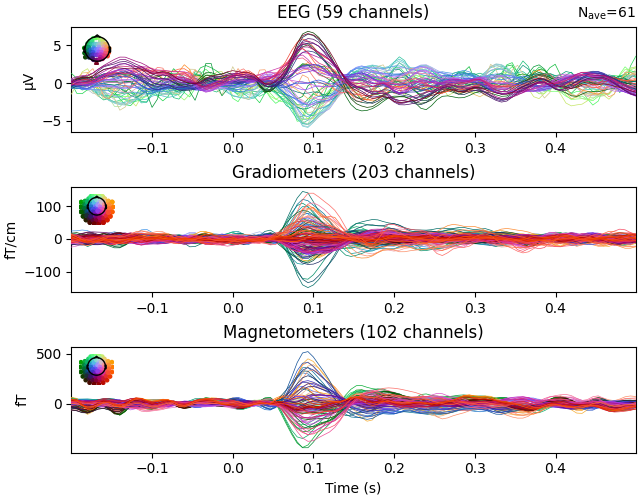
显示诱发数据:
evoked = epochs.average()

evoked.plot(time_unit="s")  # plot evoked response
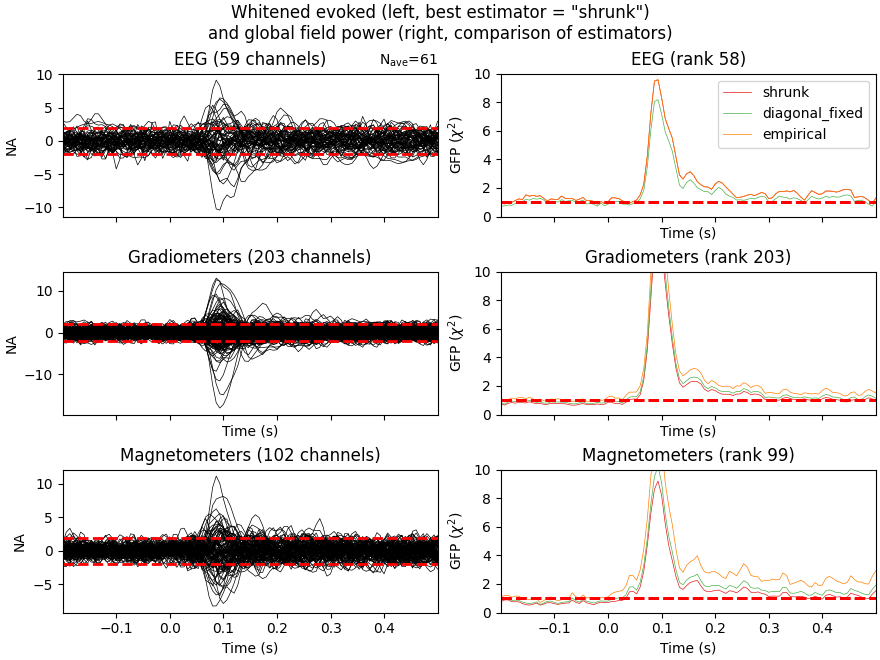
随后可以展示各种噪声协方差估计下的白化结果。
这里应检查基线信号是否符合高斯白噪声假设:期望数值以 0 为中心,95% 的时间点落在 2 个标准差以内。
对全局场功率,期望值为 1。
evoked.plot_white(noise_covs, time_unit="s")
NOTE: pick_types() is a legacy function. New code should use inst.pick(...).
Computing rank from covariance with rank=None
    Using tolerance 8.2e-14 (2.2e-16 eps * 59 dim * 6.3  max singular value)
    Estimated rank (eeg): 58
    EEG: rank 58 computed from 59 data channels with 1 projector
Computing rank from covariance with rank=None
    Using tolerance 2.8e-13 (2.2e-16 eps * 203 dim * 6.2  max singular value)
    Estimated rank (grad): 203
    GRAD: rank 203 computed from 203 data channels with 0 projectors
Computing rank from covariance with rank=None
    Using tolerance 3.6e-14 (2.2e-16 eps * 102 dim * 1.6  max singular value)
    Estimated rank (mag): 99
    MAG: rank 99 computed from 102 data channels with 3 projectors
Computing rank from covariance with rank=None
    Using tolerance 8.2e-14 (2.2e-16 eps * 59 dim * 6.3  max singular value)
    Estimated rank (eeg): 58
    EEG: rank 58 computed from 59 data channels with 1 projector
Computing rank from covariance with rank=None
    Using tolerance 2.8e-13 (2.2e-16 eps * 203 dim * 6.3  max singular value)
    Estimated rank (grad): 203
    GRAD: rank 203 computed from 203 data channels with 0 projectors
Computing rank from covariance with rank=None
    Using tolerance 3.7e-14 (2.2e-16 eps * 102 dim * 1.6  max singular value)
    Estimated rank (mag): 99
    MAG: rank 99 computed from 102 data channels with 3 projectors
    Created an SSP operator (subspace dimension = 4)
Computing rank from covariance with rank={'eeg': 58, 'grad': 203, 'mag': 99, 'meg': 302}
    Setting small MEG eigenvalues to zero (without PCA)
    Setting small EEG eigenvalues to zero (without PCA)
    Created the whitener using a noise covariance matrix with rank 360 (4 small eigenvalues omitted)
脚本总运行时间:(0 分 5.962 秒)