
说明
转到末尾下载完整示例代码。
模拟数据的时频分析(Multitaper vs. Morlet vs. Stockwell vs. Hilbert)#
本示例在模拟数据上演示不同的时频估计方法,展示时频分辨率的权衡与估计方差问题;同时介绍不跨试次平均、或直接对 NumPy 数组生成 TFR 的替代函数。
# Authors: Hari Bharadwaj <hari@nmr.mgh.harvard.edu>
#          Denis Engemann <denis.engemann@gmail.com>
#          Chris Holdgraf <choldgraf@berkeley.edu>
#          Alex Rockhill <aprockhill@mailbox.org>
#
# License: BSD-3-Clause
# Copyright the MNE-Python contributors.
import numpy as np
from matplotlib import pyplot as plt

from mne import Epochs, create_info
from mne.io import RawArray
from mne.time_frequency import AverageTFRArray, EpochsTFRArray, tfr_array_morlet

print(__doc__)
模拟数据#
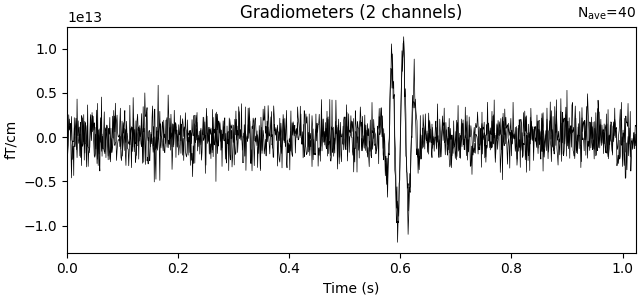
我们将模拟具有已知频谱—时间结构的数据。
sfreq = 1000.0
ch_names = ["SIM0001", "SIM0002"]
ch_types = ["grad", "grad"]
info = create_info(ch_names=ch_names, sfreq=sfreq, ch_types=ch_types)

n_times = 1024  # Just over 1 second epochs
n_epochs = 40
seed = 181
rng = np.random.default_rng(seed)
data = rng.standard_normal((len(ch_names), n_times * n_epochs + 200))  # buffer

# Add a 50 Hz sinusoidal burst to the noise and ramp it.
t = np.arange(n_times, dtype=np.float64) / sfreq
signal = np.sin(np.pi * 2.0 * 50.0 * t)  # 50 Hz sinusoid signal
signal[np.logical_or(t < 0.45, t > 0.55)] = 0.0  # hard windowing
on_time = np.logical_and(t >= 0.45, t <= 0.55)
signal[on_time] *= np.hanning(on_time.sum())  # ramping
data[:, 100:-100] += np.tile(signal, n_epochs)  # add signal

raw = RawArray(data, info)
events = np.zeros((n_epochs, 3), dtype=int)
events[:, 0] = np.arange(n_epochs) * n_times
epochs = Epochs(
    raw,
    events,
    dict(sin50hz=0),
    tmin=0,
    tmax=n_times / sfreq,
    reject=dict(grad=4000),
    baseline=None,
)

epochs.average().plot()
Creating RawArray with float64 data, n_channels=2, n_times=41160
    Range : 0 ... 41159 =      0.000 ...    41.159 secs
Ready.
Not setting metadata
40 matching events found
No baseline correction applied
0 projection items activated
Need more than one channel to make topography for grad. Disabling interactivity.
计算时频表示(TFR)#
下面演示 MNE 中若干 TFR 函数的输出:
多锥度变换#
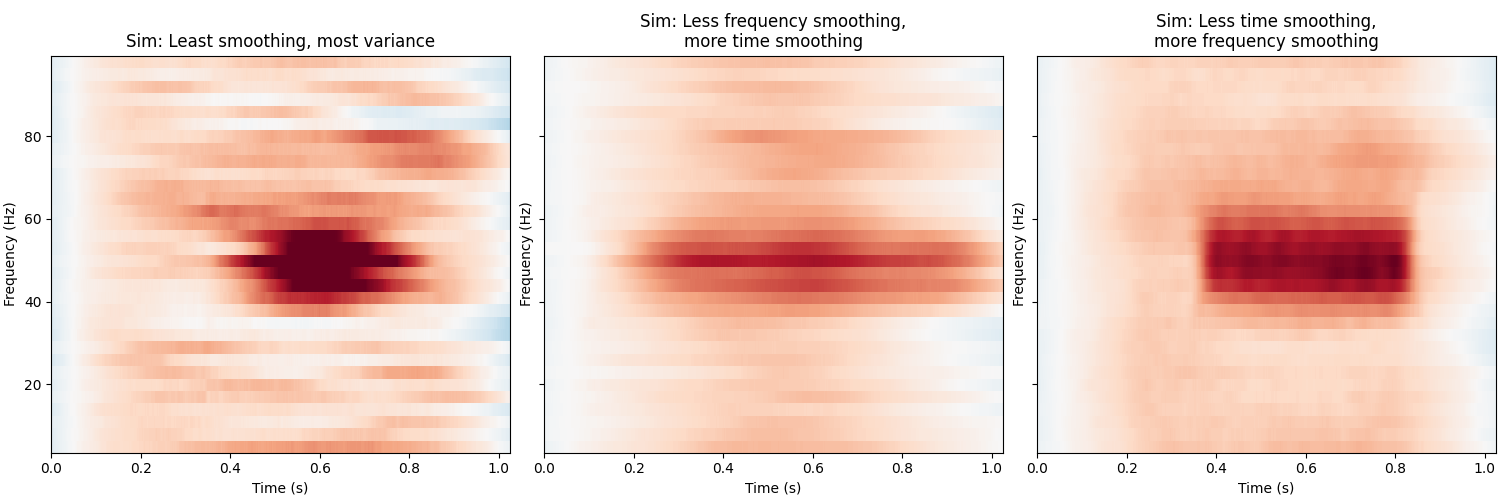
首先使用多锥度方法计算 TFR。它在 TFR 估计中构造若干正交锥度窗,从而降低方差。我们还会展示一些可调参数(如 time_bandwidth),它们会改变多锥度特性,从而得到不同的 TFR。可以牺牲时间分辨率、频率分辨率或两者,以换取方差降低。
freqs = np.arange(5.0, 100.0, 3.0)
vmin, vmax = -3.0, 3.0  # Define our color limits.

fig, axs = plt.subplots(1, 3, figsize=(15, 5), sharey=True, layout="constrained")
for n_cycles, time_bandwidth, ax, title in zip(
    [freqs / 2, freqs, freqs / 2],  # number of cycles
    [2.0, 4.0, 8.0],  # time bandwidth
    axs,
    [
        "Sim: Least smoothing, most variance",
        "Sim: Less frequency smoothing,\nmore time smoothing",
        "Sim: Less time smoothing,\nmore frequency smoothing",
    ],
):
    power = epochs.compute_tfr(
        method="multitaper",
        freqs=freqs,
        n_cycles=n_cycles,
        time_bandwidth=time_bandwidth,
        return_itc=False,
        average=True,
    )
    ax.set_title(title)
    # Plot results. Baseline correct based on first 100 ms.
    power.plot(
        [0],
        baseline=(0.0, 0.1),
        mode="mean",
        vlim=(vmin, vmax),
        axes=ax,
        show=False,
        colorbar=False,
    )
Using data from preloaded Raw for 40 events and 1025 original time points ...
0 bad epochs dropped
Applying baseline correction (mode: mean)
Using data from preloaded Raw for 40 events and 1025 original time points ...
Applying baseline correction (mode: mean)
Using data from preloaded Raw for 40 events and 1025 original time points ...
Applying baseline correction (mode: mean)
Stockwell(S)变换#
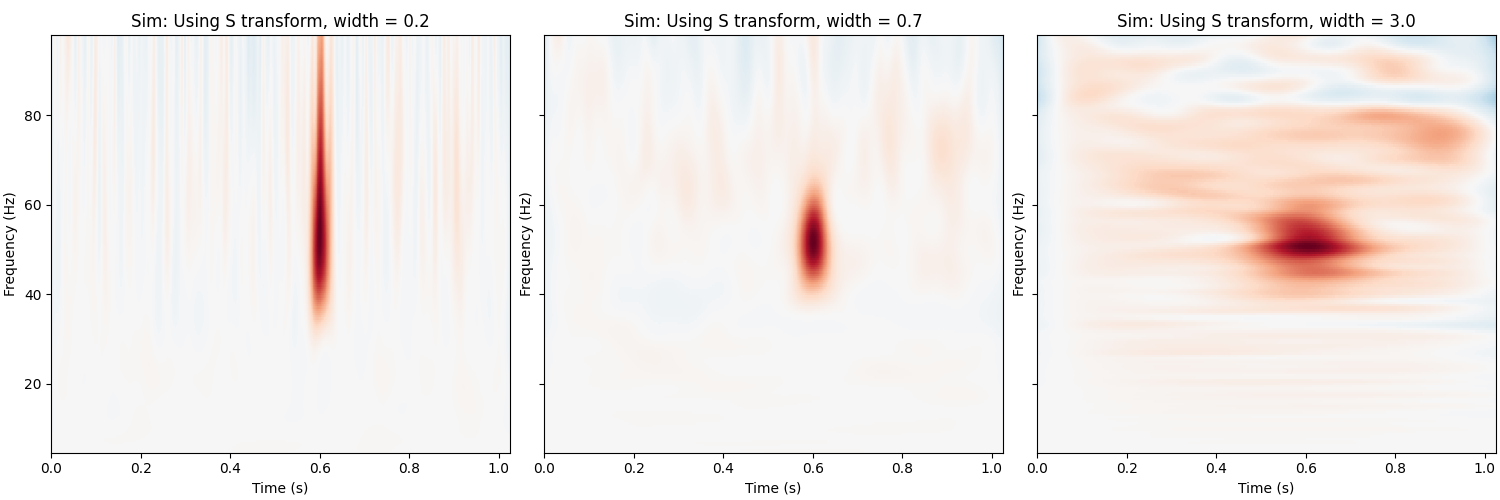
Stockwell 变换使用高斯窗平衡时间与频谱分辨率。重要的是,各频段经过相位归一化,因此在时间上严格可比;而且若忽略数值误差,输入信号可以从变换中无损恢复。这里通过 width 参数指定不同的高斯窗宽度来控制频谱/时间分辨率。
fig, axs = plt.subplots(1, 3, figsize=(15, 5), sharey=True, layout="constrained")
fmin, fmax = freqs[[0, -1]]
for width, ax in zip((0.2, 0.7, 3.0), axs):
    power = epochs.compute_tfr(method="stockwell", freqs=(fmin, fmax), width=width)
    power.plot(
        [0], baseline=(0.0, 0.1), mode="mean", axes=ax, show=False, colorbar=False
    )
    ax.set_title(f"Sim: Using S transform, width = {width:0.1f}")
Requested `method="stockwell"` so ignoring parameter `average=False`.
The input signal is shorter (1025) than "n_fft" (2048). Applying zero padding.
Using data from preloaded Raw for 40 events and 1025 original time points ...
The input signal is shorter (1025) than "n_fft" (2048). Applying zero padding.
Applying baseline correction (mode: mean)
Morlet 小波#
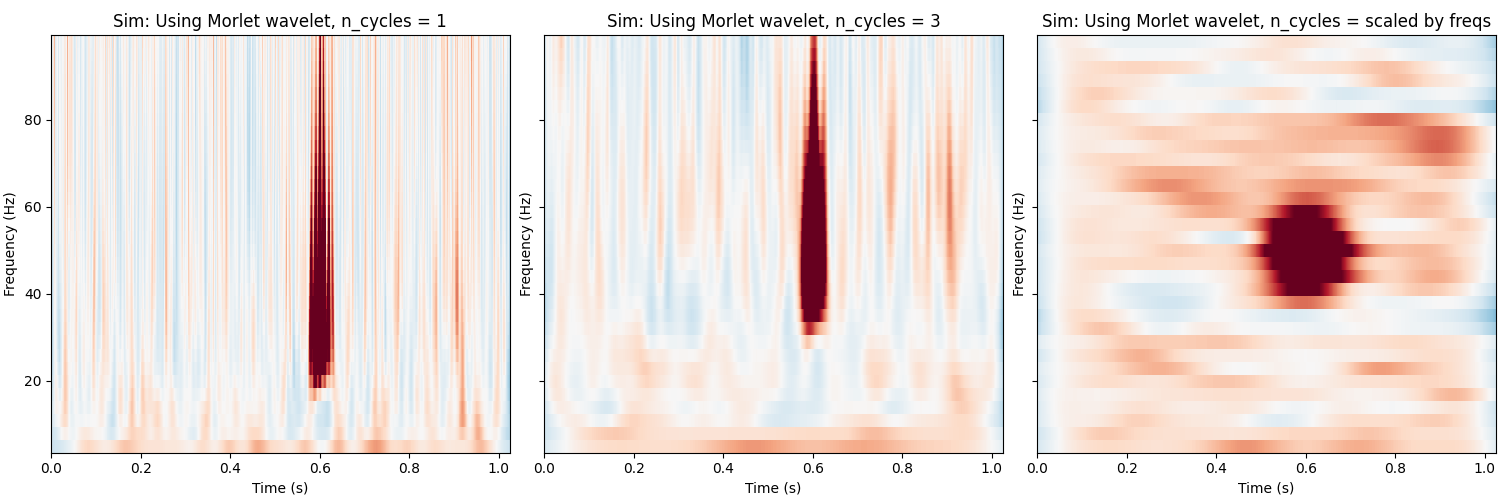
接下来展示使用 Morlet 小波的 TFR。Morlet 小波是带高斯包络的正弦波,可通过 n_cycles 参数控制频谱与时间分辨率的平衡,该参数定义窗内包含的周期数。
fig, axs = plt.subplots(1, 3, figsize=(15, 5), sharey=True, layout="constrained")
all_n_cycles = [1, 3, freqs / 2.0]
for n_cycles, ax in zip(all_n_cycles, axs):
    power = epochs.compute_tfr(
        method="morlet", freqs=freqs, n_cycles=n_cycles, return_itc=False, average=True
    )
    power.plot(
        [0],
        baseline=(0.0, 0.1),
        mode="mean",
        vlim=(vmin, vmax),
        axes=ax,
        show=False,
        colorbar=False,
    )
    n_cycles = "scaled by freqs" if not isinstance(n_cycles, int) else n_cycles
    ax.set_title(f"Sim: Using Morlet wavelet, n_cycles = {n_cycles}")
Using data from preloaded Raw for 40 events and 1025 original time points ...
Applying baseline correction (mode: mean)
Using data from preloaded Raw for 40 events and 1025 original time points ...
Applying baseline correction (mode: mean)
Using data from preloaded Raw for 40 events and 1025 original time points ...
Applying baseline correction (mode: mean)
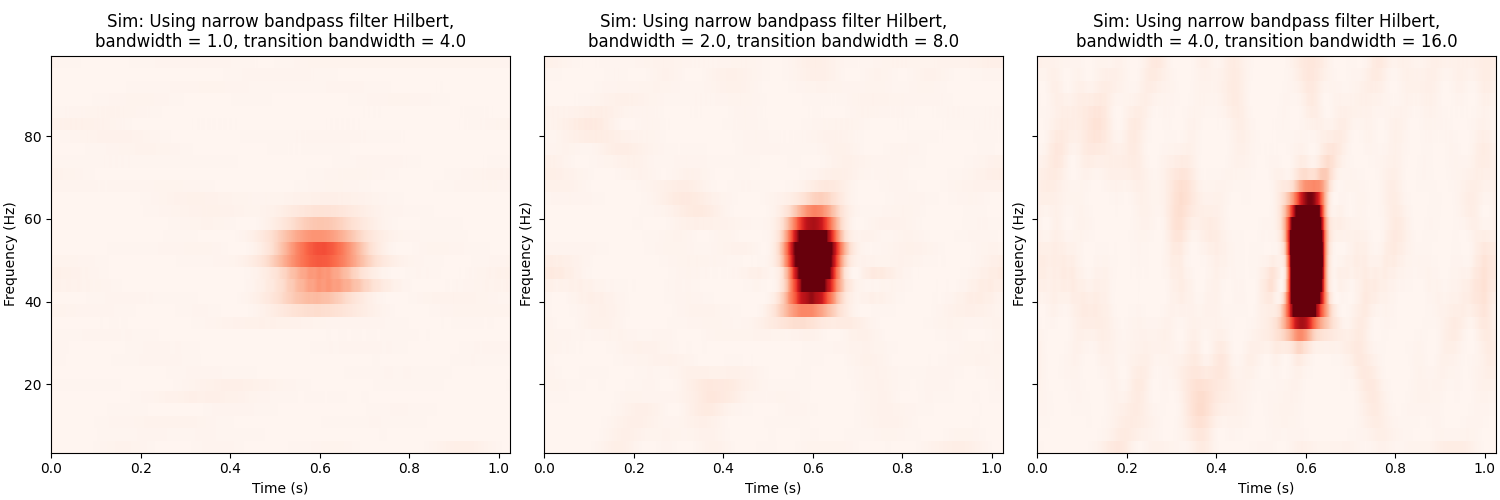
窄带通滤波与 Hilbert 变换#
最后展示使用窄带通滤波与 Hilbert 变换的时频表示。选择合适的滤波器参数很重要,以便只分离出一个感兴趣的振荡;通常建议该滤波器宽度约为 2 Hz。
fig, axs = plt.subplots(1, 3, figsize=(15, 5), sharey=True, layout="constrained")
bandwidths = [1.0, 2.0, 4.0]
for bandwidth, ax in zip(bandwidths, axs):
    data = np.zeros(
        (len(epochs), len(ch_names), freqs.size, epochs.times.size), dtype=complex
    )
    for idx, freq in enumerate(freqs):
        # Filter raw data and re-epoch to avoid the filter being longer than
        # the epoch data for low frequencies and short epochs, such as here.
        raw_filter = raw.copy()
        # NOTE: The bandwidths of the filters are changed from their defaults
        # to exaggerate differences. With the default transition bandwidths,
        # these are all very similar because the filters are almost the same.
        # In practice, using the default is usually a wise choice.
        raw_filter.filter(
            l_freq=freq - bandwidth / 2,
            h_freq=freq + bandwidth / 2,
            # no negative values for large bandwidth and low freq
            l_trans_bandwidth=min([4 * bandwidth, freq - bandwidth]),
            h_trans_bandwidth=4 * bandwidth,
        )
        raw_filter.apply_hilbert()
        epochs_hilb = Epochs(
            raw_filter, events, tmin=0, tmax=n_times / sfreq, baseline=(0, 0.1)
        )
        data[:, :, idx] = epochs_hilb.get_data()
    power = EpochsTFRArray(epochs.info, data, epochs.times, freqs, method="hilbert")
    power.average().plot(
        [0],
        baseline=(0.0, 0.1),
        mode="mean",
        vlim=(0, 0.1),
        axes=ax,
        show=False,
        colorbar=False,
    )
    n_cycles = "scaled by freqs" if not isinstance(n_cycles, int) else n_cycles
    ax.set_title(
        "Sim: Using narrow bandpass filter Hilbert,\n"
        f"bandwidth = {bandwidth}, "
        f"transition bandwidth = {4 * bandwidth}"
    )
Filtering raw data in 1 contiguous segment
Setting up band-pass filter from 4.5 - 5.5 Hz

FIR filter parameters
---------------------
Designing a one-pass, zero-phase, non-causal bandpass filter:
- Windowed time-domain design (firwin) method
- Hamming window with 0.0194 passband ripple and 53 dB stopband attenuation
- Lower passband edge: 4.50
- Lower transition bandwidth: 4.00 Hz (-6 dB cutoff frequency: 2.50 Hz)
- Upper passband edge: 5.50 Hz
- Upper transition bandwidth: 4.00 Hz (-6 dB cutoff frequency: 7.50 Hz)
- Filter length: 825 samples (0.825 s)

Not setting metadata
40 matching events found
Applying baseline correction (mode: mean)
0 projection items activated
Using data from preloaded Raw for 40 events and 1025 original time points ...
0 bad epochs dropped
Filtering raw data in 1 contiguous segment
Setting up band-pass filter from 7.5 - 8.5 Hz

FIR filter parameters
---------------------
Designing a one-pass, zero-phase, non-causal bandpass filter:
- Windowed time-domain design (firwin) method
- Hamming window with 0.0194 passband ripple and 53 dB stopband attenuation
- Lower passband edge: 7.50
- Lower transition bandwidth: 4.00 Hz (-6 dB cutoff frequency: 5.50 Hz)
- Upper passband edge: 8.50 Hz
- Upper transition bandwidth: 4.00 Hz (-6 dB cutoff frequency: 10.50 Hz)
- Filter length: 825 samples (0.825 s)

Not setting metadata
40 matching events found
Applying baseline correction (mode: mean)
0 projection items activated
Using data from preloaded Raw for 40 events and 1025 original time points ...
0 bad epochs dropped
Filtering raw data in 1 contiguous segment
Setting up band-pass filter from 10 - 12 Hz

FIR filter parameters
---------------------
Designing a one-pass, zero-phase, non-causal bandpass filter:
- Windowed time-domain design (firwin) method
- Hamming window with 0.0194 passband ripple and 53 dB stopband attenuation
- Lower passband edge: 10.50
- Lower transition bandwidth: 4.00 Hz (-6 dB cutoff frequency: 8.50 Hz)
- Upper passband edge: 11.50 Hz
- Upper transition bandwidth: 4.00 Hz (-6 dB cutoff frequency: 13.50 Hz)
- Filter length: 825 samples (0.825 s)

Not setting metadata
40 matching events found
Applying baseline correction (mode: mean)
0 projection items activated
Using data from preloaded Raw for 40 events and 1025 original time points ...
0 bad epochs dropped
Filtering raw data in 1 contiguous segment
Setting up band-pass filter from 14 - 14 Hz

FIR filter parameters
---------------------
Designing a one-pass, zero-phase, non-causal bandpass filter:
- Windowed time-domain design (firwin) method
- Hamming window with 0.0194 passband ripple and 53 dB stopband attenuation
- Lower passband edge: 13.50
- Lower transition bandwidth: 4.00 Hz (-6 dB cutoff frequency: 11.50 Hz)
- Upper passband edge: 14.50 Hz
- Upper transition bandwidth: 4.00 Hz (-6 dB cutoff frequency: 16.50 Hz)
- Filter length: 825 samples (0.825 s)

Not setting metadata
40 matching events found
Applying baseline correction (mode: mean)
0 projection items activated
Using data from preloaded Raw for 40 events and 1025 original time points ...
0 bad epochs dropped
Filtering raw data in 1 contiguous segment
Setting up band-pass filter from 16 - 18 Hz

FIR filter parameters
---------------------
Designing a one-pass, zero-phase, non-causal bandpass filter:
- Windowed time-domain design (firwin) method
- Hamming window with 0.0194 passband ripple and 53 dB stopband attenuation
- Lower passband edge: 16.50
- Lower transition bandwidth: 4.00 Hz (-6 dB cutoff frequency: 14.50 Hz)
- Upper passband edge: 17.50 Hz
- Upper transition bandwidth: 4.00 Hz (-6 dB cutoff frequency: 19.50 Hz)
- Filter length: 825 samples (0.825 s)

Not setting metadata
40 matching events found
Applying baseline correction (mode: mean)
0 projection items activated
Using data from preloaded Raw for 40 events and 1025 original time points ...
0 bad epochs dropped
Filtering raw data in 1 contiguous segment
Setting up band-pass filter from 20 - 20 Hz

FIR filter parameters
---------------------
Designing a one-pass, zero-phase, non-causal bandpass filter:
- Windowed time-domain design (firwin) method
- Hamming window with 0.0194 passband ripple and 53 dB stopband attenuation
- Lower passband edge: 19.50
- Lower transition bandwidth: 4.00 Hz (-6 dB cutoff frequency: 17.50 Hz)
- Upper passband edge: 20.50 Hz
- Upper transition bandwidth: 4.00 Hz (-6 dB cutoff frequency: 22.50 Hz)
- Filter length: 825 samples (0.825 s)

Not setting metadata
40 matching events found
Applying baseline correction (mode: mean)
0 projection items activated
Using data from preloaded Raw for 40 events and 1025 original time points ...
0 bad epochs dropped
Filtering raw data in 1 contiguous segment
Setting up band-pass filter from 22 - 24 Hz

FIR filter parameters
---------------------
Designing a one-pass, zero-phase, non-causal bandpass filter:
- Windowed time-domain design (firwin) method
- Hamming window with 0.0194 passband ripple and 53 dB stopband attenuation
- Lower passband edge: 22.50
- Lower transition bandwidth: 4.00 Hz (-6 dB cutoff frequency: 20.50 Hz)
- Upper passband edge: 23.50 Hz
- Upper transition bandwidth: 4.00 Hz (-6 dB cutoff frequency: 25.50 Hz)
- Filter length: 825 samples (0.825 s)

Not setting metadata
40 matching events found
Applying baseline correction (mode: mean)
0 projection items activated
Using data from preloaded Raw for 40 events and 1025 original time points ...
0 bad epochs dropped
Filtering raw data in 1 contiguous segment
Setting up band-pass filter from 26 - 26 Hz

FIR filter parameters
---------------------
Designing a one-pass, zero-phase, non-causal bandpass filter:
- Windowed time-domain design (firwin) method
- Hamming window with 0.0194 passband ripple and 53 dB stopband attenuation
- Lower passband edge: 25.50
- Lower transition bandwidth: 4.00 Hz (-6 dB cutoff frequency: 23.50 Hz)
- Upper passband edge: 26.50 Hz
- Upper transition bandwidth: 4.00 Hz (-6 dB cutoff frequency: 28.50 Hz)
- Filter length: 825 samples (0.825 s)

Not setting metadata
40 matching events found
Applying baseline correction (mode: mean)
0 projection items activated
Using data from preloaded Raw for 40 events and 1025 original time points ...
0 bad epochs dropped
Filtering raw data in 1 contiguous segment
Setting up band-pass filter from 28 - 30 Hz

FIR filter parameters
---------------------
Designing a one-pass, zero-phase, non-causal bandpass filter:
- Windowed time-domain design (firwin) method
- Hamming window with 0.0194 passband ripple and 53 dB stopband attenuation
- Lower passband edge: 28.50
- Lower transition bandwidth: 4.00 Hz (-6 dB cutoff frequency: 26.50 Hz)
- Upper passband edge: 29.50 Hz
- Upper transition bandwidth: 4.00 Hz (-6 dB cutoff frequency: 31.50 Hz)
- Filter length: 825 samples (0.825 s)

Not setting metadata
40 matching events found
Applying baseline correction (mode: mean)
0 projection items activated
Using data from preloaded Raw for 40 events and 1025 original time points ...
0 bad epochs dropped
Filtering raw data in 1 contiguous segment
Setting up band-pass filter from 32 - 32 Hz

FIR filter parameters
---------------------
Designing a one-pass, zero-phase, non-causal bandpass filter:
- Windowed time-domain design (firwin) method
- Hamming window with 0.0194 passband ripple and 53 dB stopband attenuation
- Lower passband edge: 31.50
- Lower transition bandwidth: 4.00 Hz (-6 dB cutoff frequency: 29.50 Hz)
- Upper passband edge: 32.50 Hz
- Upper transition bandwidth: 4.00 Hz (-6 dB cutoff frequency: 34.50 Hz)
- Filter length: 825 samples (0.825 s)

Not setting metadata
40 matching events found
Applying baseline correction (mode: mean)
0 projection items activated
Using data from preloaded Raw for 40 events and 1025 original time points ...
0 bad epochs dropped
Filtering raw data in 1 contiguous segment
Setting up band-pass filter from 34 - 36 Hz

FIR filter parameters
---------------------
Designing a one-pass, zero-phase, non-causal bandpass filter:
- Windowed time-domain design (firwin) method
- Hamming window with 0.0194 passband ripple and 53 dB stopband attenuation
- Lower passband edge: 34.50
- Lower transition bandwidth: 4.00 Hz (-6 dB cutoff frequency: 32.50 Hz)
- Upper passband edge: 35.50 Hz
- Upper transition bandwidth: 4.00 Hz (-6 dB cutoff frequency: 37.50 Hz)
- Filter length: 825 samples (0.825 s)

Not setting metadata
40 matching events found
Applying baseline correction (mode: mean)
0 projection items activated
Using data from preloaded Raw for 40 events and 1025 original time points ...
0 bad epochs dropped
Filtering raw data in 1 contiguous segment
Setting up band-pass filter from 38 - 38 Hz

FIR filter parameters
---------------------
Designing a one-pass, zero-phase, non-causal bandpass filter:
- Windowed time-domain design (firwin) method
- Hamming window with 0.0194 passband ripple and 53 dB stopband attenuation
- Lower passband edge: 37.50
- Lower transition bandwidth: 4.00 Hz (-6 dB cutoff frequency: 35.50 Hz)
- Upper passband edge: 38.50 Hz
- Upper transition bandwidth: 4.00 Hz (-6 dB cutoff frequency: 40.50 Hz)
- Filter length: 825 samples (0.825 s)

Not setting metadata
40 matching events found
Applying baseline correction (mode: mean)
0 projection items activated
Using data from preloaded Raw for 40 events and 1025 original time points ...
0 bad epochs dropped
Filtering raw data in 1 contiguous segment
Setting up band-pass filter from 40 - 42 Hz

FIR filter parameters
---------------------
Designing a one-pass, zero-phase, non-causal bandpass filter:
- Windowed time-domain design (firwin) method
- Hamming window with 0.0194 passband ripple and 53 dB stopband attenuation
- Lower passband edge: 40.50
- Lower transition bandwidth: 4.00 Hz (-6 dB cutoff frequency: 38.50 Hz)
- Upper passband edge: 41.50 Hz
- Upper transition bandwidth: 4.00 Hz (-6 dB cutoff frequency: 43.50 Hz)
- Filter length: 825 samples (0.825 s)

Not setting metadata
40 matching events found
Applying baseline correction (mode: mean)
0 projection items activated
Using data from preloaded Raw for 40 events and 1025 original time points ...
0 bad epochs dropped
Filtering raw data in 1 contiguous segment
Setting up band-pass filter from 44 - 44 Hz

FIR filter parameters
---------------------
Designing a one-pass, zero-phase, non-causal bandpass filter:
- Windowed time-domain design (firwin) method
- Hamming window with 0.0194 passband ripple and 53 dB stopband attenuation
- Lower passband edge: 43.50
- Lower transition bandwidth: 4.00 Hz (-6 dB cutoff frequency: 41.50 Hz)
- Upper passband edge: 44.50 Hz
- Upper transition bandwidth: 4.00 Hz (-6 dB cutoff frequency: 46.50 Hz)
- Filter length: 825 samples (0.825 s)

Not setting metadata
40 matching events found
Applying baseline correction (mode: mean)
0 projection items activated
Using data from preloaded Raw for 40 events and 1025 original time points ...
0 bad epochs dropped
Filtering raw data in 1 contiguous segment
Setting up band-pass filter from 46 - 48 Hz

FIR filter parameters
---------------------
Designing a one-pass, zero-phase, non-causal bandpass filter:
- Windowed time-domain design (firwin) method
- Hamming window with 0.0194 passband ripple and 53 dB stopband attenuation
- Lower passband edge: 46.50
- Lower transition bandwidth: 4.00 Hz (-6 dB cutoff frequency: 44.50 Hz)
- Upper passband edge: 47.50 Hz
- Upper transition bandwidth: 4.00 Hz (-6 dB cutoff frequency: 49.50 Hz)
- Filter length: 825 samples (0.825 s)

Not setting metadata
40 matching events found
Applying baseline correction (mode: mean)
0 projection items activated
Using data from preloaded Raw for 40 events and 1025 original time points ...
0 bad epochs dropped
Filtering raw data in 1 contiguous segment
Setting up band-pass filter from 50 - 50 Hz

FIR filter parameters
---------------------
Designing a one-pass, zero-phase, non-causal bandpass filter:
- Windowed time-domain design (firwin) method
- Hamming window with 0.0194 passband ripple and 53 dB stopband attenuation
- Lower passband edge: 49.50
- Lower transition bandwidth: 4.00 Hz (-6 dB cutoff frequency: 47.50 Hz)
- Upper passband edge: 50.50 Hz
- Upper transition bandwidth: 4.00 Hz (-6 dB cutoff frequency: 52.50 Hz)
- Filter length: 825 samples (0.825 s)

Not setting metadata
40 matching events found
Applying baseline correction (mode: mean)
0 projection items activated
Using data from preloaded Raw for 40 events and 1025 original time points ...
0 bad epochs dropped
Filtering raw data in 1 contiguous segment
Setting up band-pass filter from 52 - 54 Hz

FIR filter parameters
---------------------
Designing a one-pass, zero-phase, non-causal bandpass filter:
- Windowed time-domain design (firwin) method
- Hamming window with 0.0194 passband ripple and 53 dB stopband attenuation
- Lower passband edge: 52.50
- Lower transition bandwidth: 4.00 Hz (-6 dB cutoff frequency: 50.50 Hz)
- Upper passband edge: 53.50 Hz
- Upper transition bandwidth: 4.00 Hz (-6 dB cutoff frequency: 55.50 Hz)
- Filter length: 825 samples (0.825 s)

Not setting metadata
40 matching events found
Applying baseline correction (mode: mean)
0 projection items activated
Using data from preloaded Raw for 40 events and 1025 original time points ...
0 bad epochs dropped
Filtering raw data in 1 contiguous segment
Setting up band-pass filter from 56 - 56 Hz

FIR filter parameters
---------------------
Designing a one-pass, zero-phase, non-causal bandpass filter:
- Windowed time-domain design (firwin) method
- Hamming window with 0.0194 passband ripple and 53 dB stopband attenuation
- Lower passband edge: 55.50
- Lower transition bandwidth: 4.00 Hz (-6 dB cutoff frequency: 53.50 Hz)
- Upper passband edge: 56.50 Hz
- Upper transition bandwidth: 4.00 Hz (-6 dB cutoff frequency: 58.50 Hz)
- Filter length: 825 samples (0.825 s)

Not setting metadata
40 matching events found
Applying baseline correction (mode: mean)
0 projection items activated
Using data from preloaded Raw for 40 events and 1025 original time points ...
0 bad epochs dropped
Filtering raw data in 1 contiguous segment
Setting up band-pass filter from 58 - 60 Hz

FIR filter parameters
---------------------
Designing a one-pass, zero-phase, non-causal bandpass filter:
- Windowed time-domain design (firwin) method
- Hamming window with 0.0194 passband ripple and 53 dB stopband attenuation
- Lower passband edge: 58.50
- Lower transition bandwidth: 4.00 Hz (-6 dB cutoff frequency: 56.50 Hz)
- Upper passband edge: 59.50 Hz
- Upper transition bandwidth: 4.00 Hz (-6 dB cutoff frequency: 61.50 Hz)
- Filter length: 825 samples (0.825 s)

Not setting metadata
40 matching events found
Applying baseline correction (mode: mean)
0 projection items activated
Using data from preloaded Raw for 40 events and 1025 original time points ...
0 bad epochs dropped
Filtering raw data in 1 contiguous segment
Setting up band-pass filter from 62 - 62 Hz

FIR filter parameters
---------------------
Designing a one-pass, zero-phase, non-causal bandpass filter:
- Windowed time-domain design (firwin) method
- Hamming window with 0.0194 passband ripple and 53 dB stopband attenuation
- Lower passband edge: 61.50
- Lower transition bandwidth: 4.00 Hz (-6 dB cutoff frequency: 59.50 Hz)
- Upper passband edge: 62.50 Hz
- Upper transition bandwidth: 4.00 Hz (-6 dB cutoff frequency: 64.50 Hz)
- Filter length: 825 samples (0.825 s)

Not setting metadata
40 matching events found
Applying baseline correction (mode: mean)
0 projection items activated
Using data from preloaded Raw for 40 events and 1025 original time points ...
0 bad epochs dropped
Filtering raw data in 1 contiguous segment
Setting up band-pass filter from 64 - 66 Hz

FIR filter parameters
---------------------
Designing a one-pass, zero-phase, non-causal bandpass filter:
- Windowed time-domain design (firwin) method
- Hamming window with 0.0194 passband ripple and 53 dB stopband attenuation
- Lower passband edge: 64.50
- Lower transition bandwidth: 4.00 Hz (-6 dB cutoff frequency: 62.50 Hz)
- Upper passband edge: 65.50 Hz
- Upper transition bandwidth: 4.00 Hz (-6 dB cutoff frequency: 67.50 Hz)
- Filter length: 825 samples (0.825 s)

Not setting metadata
40 matching events found
Applying baseline correction (mode: mean)
0 projection items activated
Using data from preloaded Raw for 40 events and 1025 original time points ...
0 bad epochs dropped
Filtering raw data in 1 contiguous segment
Setting up band-pass filter from 68 - 68 Hz

FIR filter parameters
---------------------
Designing a one-pass, zero-phase, non-causal bandpass filter:
- Windowed time-domain design (firwin) method
- Hamming window with 0.0194 passband ripple and 53 dB stopband attenuation
- Lower passband edge: 67.50
- Lower transition bandwidth: 4.00 Hz (-6 dB cutoff frequency: 65.50 Hz)
- Upper passband edge: 68.50 Hz
- Upper transition bandwidth: 4.00 Hz (-6 dB cutoff frequency: 70.50 Hz)
- Filter length: 825 samples (0.825 s)

Not setting metadata
40 matching events found
Applying baseline correction (mode: mean)
0 projection items activated
Using data from preloaded Raw for 40 events and 1025 original time points ...
0 bad epochs dropped
Filtering raw data in 1 contiguous segment
Setting up band-pass filter from 70 - 72 Hz

FIR filter parameters
---------------------
Designing a one-pass, zero-phase, non-causal bandpass filter:
- Windowed time-domain design (firwin) method
- Hamming window with 0.0194 passband ripple and 53 dB stopband attenuation
- Lower passband edge: 70.50
- Lower transition bandwidth: 4.00 Hz (-6 dB cutoff frequency: 68.50 Hz)
- Upper passband edge: 71.50 Hz
- Upper transition bandwidth: 4.00 Hz (-6 dB cutoff frequency: 73.50 Hz)
- Filter length: 825 samples (0.825 s)

Not setting metadata
40 matching events found
Applying baseline correction (mode: mean)
0 projection items activated
Using data from preloaded Raw for 40 events and 1025 original time points ...
0 bad epochs dropped
Filtering raw data in 1 contiguous segment
Setting up band-pass filter from 74 - 74 Hz

FIR filter parameters
---------------------
Designing a one-pass, zero-phase, non-causal bandpass filter:
- Windowed time-domain design (firwin) method
- Hamming window with 0.0194 passband ripple and 53 dB stopband attenuation
- Lower passband edge: 73.50
- Lower transition bandwidth: 4.00 Hz (-6 dB cutoff frequency: 71.50 Hz)
- Upper passband edge: 74.50 Hz
- Upper transition bandwidth: 4.00 Hz (-6 dB cutoff frequency: 76.50 Hz)
- Filter length: 825 samples (0.825 s)

Not setting metadata
40 matching events found
Applying baseline correction (mode: mean)
0 projection items activated
Using data from preloaded Raw for 40 events and 1025 original time points ...
0 bad epochs dropped
Filtering raw data in 1 contiguous segment
Setting up band-pass filter from 76 - 78 Hz

FIR filter parameters
---------------------
Designing a one-pass, zero-phase, non-causal bandpass filter:
- Windowed time-domain design (firwin) method
- Hamming window with 0.0194 passband ripple and 53 dB stopband attenuation
- Lower passband edge: 76.50
- Lower transition bandwidth: 4.00 Hz (-6 dB cutoff frequency: 74.50 Hz)
- Upper passband edge: 77.50 Hz
- Upper transition bandwidth: 4.00 Hz (-6 dB cutoff frequency: 79.50 Hz)
- Filter length: 825 samples (0.825 s)

Not setting metadata
40 matching events found
Applying baseline correction (mode: mean)
0 projection items activated
Using data from preloaded Raw for 40 events and 1025 original time points ...
0 bad epochs dropped
Filtering raw data in 1 contiguous segment
Setting up band-pass filter from 80 - 80 Hz

FIR filter parameters
---------------------
Designing a one-pass, zero-phase, non-causal bandpass filter:
- Windowed time-domain design (firwin) method
- Hamming window with 0.0194 passband ripple and 53 dB stopband attenuation
- Lower passband edge: 79.50
- Lower transition bandwidth: 4.00 Hz (-6 dB cutoff frequency: 77.50 Hz)
- Upper passband edge: 80.50 Hz
- Upper transition bandwidth: 4.00 Hz (-6 dB cutoff frequency: 82.50 Hz)
- Filter length: 825 samples (0.825 s)

Not setting metadata
40 matching events found
Applying baseline correction (mode: mean)
0 projection items activated
Using data from preloaded Raw for 40 events and 1025 original time points ...
0 bad epochs dropped
Filtering raw data in 1 contiguous segment
Setting up band-pass filter from 82 - 84 Hz

FIR filter parameters
---------------------
Designing a one-pass, zero-phase, non-causal bandpass filter:
- Windowed time-domain design (firwin) method
- Hamming window with 0.0194 passband ripple and 53 dB stopband attenuation
- Lower passband edge: 82.50
- Lower transition bandwidth: 4.00 Hz (-6 dB cutoff frequency: 80.50 Hz)
- Upper passband edge: 83.50 Hz
- Upper transition bandwidth: 4.00 Hz (-6 dB cutoff frequency: 85.50 Hz)
- Filter length: 825 samples (0.825 s)

Not setting metadata
40 matching events found
Applying baseline correction (mode: mean)
0 projection items activated
Using data from preloaded Raw for 40 events and 1025 original time points ...
0 bad epochs dropped
Filtering raw data in 1 contiguous segment
Setting up band-pass filter from 86 - 86 Hz

FIR filter parameters
---------------------
Designing a one-pass, zero-phase, non-causal bandpass filter:
- Windowed time-domain design (firwin) method
- Hamming window with 0.0194 passband ripple and 53 dB stopband attenuation
- Lower passband edge: 85.50
- Lower transition bandwidth: 4.00 Hz (-6 dB cutoff frequency: 83.50 Hz)
- Upper passband edge: 86.50 Hz
- Upper transition bandwidth: 4.00 Hz (-6 dB cutoff frequency: 88.50 Hz)
- Filter length: 825 samples (0.825 s)

Not setting metadata
40 matching events found
Applying baseline correction (mode: mean)
0 projection items activated
Using data from preloaded Raw for 40 events and 1025 original time points ...
0 bad epochs dropped
Filtering raw data in 1 contiguous segment
Setting up band-pass filter from 88 - 90 Hz

FIR filter parameters
---------------------
Designing a one-pass, zero-phase, non-causal bandpass filter:
- Windowed time-domain design (firwin) method
- Hamming window with 0.0194 passband ripple and 53 dB stopband attenuation
- Lower passband edge: 88.50
- Lower transition bandwidth: 4.00 Hz (-6 dB cutoff frequency: 86.50 Hz)
- Upper passband edge: 89.50 Hz
- Upper transition bandwidth: 4.00 Hz (-6 dB cutoff frequency: 91.50 Hz)
- Filter length: 825 samples (0.825 s)

Not setting metadata
40 matching events found
Applying baseline correction (mode: mean)
0 projection items activated
Using data from preloaded Raw for 40 events and 1025 original time points ...
0 bad epochs dropped
Filtering raw data in 1 contiguous segment
Setting up band-pass filter from 92 - 92 Hz

FIR filter parameters
---------------------
Designing a one-pass, zero-phase, non-causal bandpass filter:
- Windowed time-domain design (firwin) method
- Hamming window with 0.0194 passband ripple and 53 dB stopband attenuation
- Lower passband edge: 91.50
- Lower transition bandwidth: 4.00 Hz (-6 dB cutoff frequency: 89.50 Hz)
- Upper passband edge: 92.50 Hz
- Upper transition bandwidth: 4.00 Hz (-6 dB cutoff frequency: 94.50 Hz)
- Filter length: 825 samples (0.825 s)

Not setting metadata
40 matching events found
Applying baseline correction (mode: mean)
0 projection items activated
Using data from preloaded Raw for 40 events and 1025 original time points ...
0 bad epochs dropped
Filtering raw data in 1 contiguous segment
Setting up band-pass filter from 94 - 96 Hz

FIR filter parameters
---------------------
Designing a one-pass, zero-phase, non-causal bandpass filter:
- Windowed time-domain design (firwin) method
- Hamming window with 0.0194 passband ripple and 53 dB stopband attenuation
- Lower passband edge: 94.50
- Lower transition bandwidth: 4.00 Hz (-6 dB cutoff frequency: 92.50 Hz)
- Upper passband edge: 95.50 Hz
- Upper transition bandwidth: 4.00 Hz (-6 dB cutoff frequency: 97.50 Hz)
- Filter length: 825 samples (0.825 s)

Not setting metadata
40 matching events found
Applying baseline correction (mode: mean)
0 projection items activated
Using data from preloaded Raw for 40 events and 1025 original time points ...
0 bad epochs dropped
Filtering raw data in 1 contiguous segment
Setting up band-pass filter from 98 - 98 Hz

FIR filter parameters
---------------------
Designing a one-pass, zero-phase, non-causal bandpass filter:
- Windowed time-domain design (firwin) method
- Hamming window with 0.0194 passband ripple and 53 dB stopband attenuation
- Lower passband edge: 97.50
- Lower transition bandwidth: 4.00 Hz (-6 dB cutoff frequency: 95.50 Hz)
- Upper passband edge: 98.50 Hz
- Upper transition bandwidth: 4.00 Hz (-6 dB cutoff frequency: 100.50 Hz)
- Filter length: 825 samples (0.825 s)

Not setting metadata
40 matching events found
Applying baseline correction (mode: mean)
0 projection items activated
Using data from preloaded Raw for 40 events and 1025 original time points ...
0 bad epochs dropped
Applying baseline correction (mode: mean)
Filtering raw data in 1 contiguous segment
Setting up band-pass filter from 4 - 6 Hz

FIR filter parameters
---------------------
Designing a one-pass, zero-phase, non-causal bandpass filter:
- Windowed time-domain design (firwin) method
- Hamming window with 0.0194 passband ripple and 53 dB stopband attenuation
- Lower passband edge: 4.00
- Lower transition bandwidth: 3.00 Hz (-6 dB cutoff frequency: 2.50 Hz)
- Upper passband edge: 6.00 Hz
- Upper transition bandwidth: 8.00 Hz (-6 dB cutoff frequency: 10.00 Hz)
- Filter length: 1101 samples (1.101 s)

Not setting metadata
40 matching events found
Applying baseline correction (mode: mean)
0 projection items activated
Using data from preloaded Raw for 40 events and 1025 original time points ...
0 bad epochs dropped
Filtering raw data in 1 contiguous segment
Setting up band-pass filter from 7 - 9 Hz

FIR filter parameters
---------------------
Designing a one-pass, zero-phase, non-causal bandpass filter:
- Windowed time-domain design (firwin) method
- Hamming window with 0.0194 passband ripple and 53 dB stopband attenuation
- Lower passband edge: 7.00
- Lower transition bandwidth: 6.00 Hz (-6 dB cutoff frequency: 4.00 Hz)
- Upper passband edge: 9.00 Hz
- Upper transition bandwidth: 8.00 Hz (-6 dB cutoff frequency: 13.00 Hz)
- Filter length: 551 samples (0.551 s)

Not setting metadata
40 matching events found
Applying baseline correction (mode: mean)
0 projection items activated
Using data from preloaded Raw for 40 events and 1025 original time points ...
0 bad epochs dropped
Filtering raw data in 1 contiguous segment
Setting up band-pass filter from 10 - 12 Hz

FIR filter parameters
---------------------
Designing a one-pass, zero-phase, non-causal bandpass filter:
- Windowed time-domain design (firwin) method
- Hamming window with 0.0194 passband ripple and 53 dB stopband attenuation
- Lower passband edge: 10.00
- Lower transition bandwidth: 8.00 Hz (-6 dB cutoff frequency: 6.00 Hz)
- Upper passband edge: 12.00 Hz
- Upper transition bandwidth: 8.00 Hz (-6 dB cutoff frequency: 16.00 Hz)
- Filter length: 413 samples (0.413 s)

Not setting metadata
40 matching events found
Applying baseline correction (mode: mean)
0 projection items activated
Using data from preloaded Raw for 40 events and 1025 original time points ...
0 bad epochs dropped
Filtering raw data in 1 contiguous segment
Setting up band-pass filter from 13 - 15 Hz

FIR filter parameters
---------------------
Designing a one-pass, zero-phase, non-causal bandpass filter:
- Windowed time-domain design (firwin) method
- Hamming window with 0.0194 passband ripple and 53 dB stopband attenuation
- Lower passband edge: 13.00
- Lower transition bandwidth: 8.00 Hz (-6 dB cutoff frequency: 9.00 Hz)
- Upper passband edge: 15.00 Hz
- Upper transition bandwidth: 8.00 Hz (-6 dB cutoff frequency: 19.00 Hz)
- Filter length: 413 samples (0.413 s)

Not setting metadata
40 matching events found
Applying baseline correction (mode: mean)
0 projection items activated
Using data from preloaded Raw for 40 events and 1025 original time points ...
0 bad epochs dropped
Filtering raw data in 1 contiguous segment
Setting up band-pass filter from 16 - 18 Hz

FIR filter parameters
---------------------
Designing a one-pass, zero-phase, non-causal bandpass filter:
- Windowed time-domain design (firwin) method
- Hamming window with 0.0194 passband ripple and 53 dB stopband attenuation
- Lower passband edge: 16.00
- Lower transition bandwidth: 8.00 Hz (-6 dB cutoff frequency: 12.00 Hz)
- Upper passband edge: 18.00 Hz
- Upper transition bandwidth: 8.00 Hz (-6 dB cutoff frequency: 22.00 Hz)
- Filter length: 413 samples (0.413 s)

Not setting metadata
40 matching events found
Applying baseline correction (mode: mean)
0 projection items activated
Using data from preloaded Raw for 40 events and 1025 original time points ...
0 bad epochs dropped
Filtering raw data in 1 contiguous segment
Setting up band-pass filter from 19 - 21 Hz

FIR filter parameters
---------------------
Designing a one-pass, zero-phase, non-causal bandpass filter:
- Windowed time-domain design (firwin) method
- Hamming window with 0.0194 passband ripple and 53 dB stopband attenuation
- Lower passband edge: 19.00
- Lower transition bandwidth: 8.00 Hz (-6 dB cutoff frequency: 15.00 Hz)
- Upper passband edge: 21.00 Hz
- Upper transition bandwidth: 8.00 Hz (-6 dB cutoff frequency: 25.00 Hz)
- Filter length: 413 samples (0.413 s)

Not setting metadata
40 matching events found
Applying baseline correction (mode: mean)
0 projection items activated
Using data from preloaded Raw for 40 events and 1025 original time points ...
0 bad epochs dropped
Filtering raw data in 1 contiguous segment
Setting up band-pass filter from 22 - 24 Hz

FIR filter parameters
---------------------
Designing a one-pass, zero-phase, non-causal bandpass filter:
- Windowed time-domain design (firwin) method
- Hamming window with 0.0194 passband ripple and 53 dB stopband attenuation
- Lower passband edge: 22.00
- Lower transition bandwidth: 8.00 Hz (-6 dB cutoff frequency: 18.00 Hz)
- Upper passband edge: 24.00 Hz
- Upper transition bandwidth: 8.00 Hz (-6 dB cutoff frequency: 28.00 Hz)
- Filter length: 413 samples (0.413 s)

Not setting metadata
40 matching events found
Applying baseline correction (mode: mean)
0 projection items activated
Using data from preloaded Raw for 40 events and 1025 original time points ...
0 bad epochs dropped
Filtering raw data in 1 contiguous segment
Setting up band-pass filter from 25 - 27 Hz

FIR filter parameters
---------------------
Designing a one-pass, zero-phase, non-causal bandpass filter:
- Windowed time-domain design (firwin) method
- Hamming window with 0.0194 passband ripple and 53 dB stopband attenuation
- Lower passband edge: 25.00
- Lower transition bandwidth: 8.00 Hz (-6 dB cutoff frequency: 21.00 Hz)
- Upper passband edge: 27.00 Hz
- Upper transition bandwidth: 8.00 Hz (-6 dB cutoff frequency: 31.00 Hz)
- Filter length: 413 samples (0.413 s)

Not setting metadata
40 matching events found
Applying baseline correction (mode: mean)
0 projection items activated
Using data from preloaded Raw for 40 events and 1025 original time points ...
0 bad epochs dropped
Filtering raw data in 1 contiguous segment
Setting up band-pass filter from 28 - 30 Hz

FIR filter parameters
---------------------
Designing a one-pass, zero-phase, non-causal bandpass filter:
- Windowed time-domain design (firwin) method
- Hamming window with 0.0194 passband ripple and 53 dB stopband attenuation
- Lower passband edge: 28.00
- Lower transition bandwidth: 8.00 Hz (-6 dB cutoff frequency: 24.00 Hz)
- Upper passband edge: 30.00 Hz
- Upper transition bandwidth: 8.00 Hz (-6 dB cutoff frequency: 34.00 Hz)
- Filter length: 413 samples (0.413 s)

Not setting metadata
40 matching events found
Applying baseline correction (mode: mean)
0 projection items activated
Using data from preloaded Raw for 40 events and 1025 original time points ...
0 bad epochs dropped
Filtering raw data in 1 contiguous segment
Setting up band-pass filter from 31 - 33 Hz

FIR filter parameters
---------------------
Designing a one-pass, zero-phase, non-causal bandpass filter:
- Windowed time-domain design (firwin) method
- Hamming window with 0.0194 passband ripple and 53 dB stopband attenuation
- Lower passband edge: 31.00
- Lower transition bandwidth: 8.00 Hz (-6 dB cutoff frequency: 27.00 Hz)
- Upper passband edge: 33.00 Hz
- Upper transition bandwidth: 8.00 Hz (-6 dB cutoff frequency: 37.00 Hz)
- Filter length: 413 samples (0.413 s)

Not setting metadata
40 matching events found
Applying baseline correction (mode: mean)
0 projection items activated
Using data from preloaded Raw for 40 events and 1025 original time points ...
0 bad epochs dropped
Filtering raw data in 1 contiguous segment
Setting up band-pass filter from 34 - 36 Hz

FIR filter parameters
---------------------
Designing a one-pass, zero-phase, non-causal bandpass filter:
- Windowed time-domain design (firwin) method
- Hamming window with 0.0194 passband ripple and 53 dB stopband attenuation
- Lower passband edge: 34.00
- Lower transition bandwidth: 8.00 Hz (-6 dB cutoff frequency: 30.00 Hz)
- Upper passband edge: 36.00 Hz
- Upper transition bandwidth: 8.00 Hz (-6 dB cutoff frequency: 40.00 Hz)
- Filter length: 413 samples (0.413 s)

Not setting metadata
40 matching events found
Applying baseline correction (mode: mean)
0 projection items activated
Using data from preloaded Raw for 40 events and 1025 original time points ...
0 bad epochs dropped
Filtering raw data in 1 contiguous segment
Setting up band-pass filter from 37 - 39 Hz

FIR filter parameters
---------------------
Designing a one-pass, zero-phase, non-causal bandpass filter:
- Windowed time-domain design (firwin) method
- Hamming window with 0.0194 passband ripple and 53 dB stopband attenuation
- Lower passband edge: 37.00
- Lower transition bandwidth: 8.00 Hz (-6 dB cutoff frequency: 33.00 Hz)
- Upper passband edge: 39.00 Hz
- Upper transition bandwidth: 8.00 Hz (-6 dB cutoff frequency: 43.00 Hz)
- Filter length: 413 samples (0.413 s)

Not setting metadata
40 matching events found
Applying baseline correction (mode: mean)
0 projection items activated
Using data from preloaded Raw for 40 events and 1025 original time points ...
0 bad epochs dropped
Filtering raw data in 1 contiguous segment
Setting up band-pass filter from 40 - 42 Hz

FIR filter parameters
---------------------
Designing a one-pass, zero-phase, non-causal bandpass filter:
- Windowed time-domain design (firwin) method
- Hamming window with 0.0194 passband ripple and 53 dB stopband attenuation
- Lower passband edge: 40.00
- Lower transition bandwidth: 8.00 Hz (-6 dB cutoff frequency: 36.00 Hz)
- Upper passband edge: 42.00 Hz
- Upper transition bandwidth: 8.00 Hz (-6 dB cutoff frequency: 46.00 Hz)
- Filter length: 413 samples (0.413 s)

Not setting metadata
40 matching events found
Applying baseline correction (mode: mean)
0 projection items activated
Using data from preloaded Raw for 40 events and 1025 original time points ...
0 bad epochs dropped
Filtering raw data in 1 contiguous segment
Setting up band-pass filter from 43 - 45 Hz

FIR filter parameters
---------------------
Designing a one-pass, zero-phase, non-causal bandpass filter:
- Windowed time-domain design (firwin) method
- Hamming window with 0.0194 passband ripple and 53 dB stopband attenuation
- Lower passband edge: 43.00
- Lower transition bandwidth: 8.00 Hz (-6 dB cutoff frequency: 39.00 Hz)
- Upper passband edge: 45.00 Hz
- Upper transition bandwidth: 8.00 Hz (-6 dB cutoff frequency: 49.00 Hz)
- Filter length: 413 samples (0.413 s)

Not setting metadata
40 matching events found
Applying baseline correction (mode: mean)
0 projection items activated
Using data from preloaded Raw for 40 events and 1025 original time points ...
0 bad epochs dropped
Filtering raw data in 1 contiguous segment
Setting up band-pass filter from 46 - 48 Hz

FIR filter parameters
---------------------
Designing a one-pass, zero-phase, non-causal bandpass filter:
- Windowed time-domain design (firwin) method
- Hamming window with 0.0194 passband ripple and 53 dB stopband attenuation
- Lower passband edge: 46.00
- Lower transition bandwidth: 8.00 Hz (-6 dB cutoff frequency: 42.00 Hz)
- Upper passband edge: 48.00 Hz
- Upper transition bandwidth: 8.00 Hz (-6 dB cutoff frequency: 52.00 Hz)
- Filter length: 413 samples (0.413 s)

Not setting metadata
40 matching events found
Applying baseline correction (mode: mean)
0 projection items activated
Using data from preloaded Raw for 40 events and 1025 original time points ...
0 bad epochs dropped
Filtering raw data in 1 contiguous segment
Setting up band-pass filter from 49 - 51 Hz

FIR filter parameters
---------------------
Designing a one-pass, zero-phase, non-causal bandpass filter:
- Windowed time-domain design (firwin) method
- Hamming window with 0.0194 passband ripple and 53 dB stopband attenuation
- Lower passband edge: 49.00
- Lower transition bandwidth: 8.00 Hz (-6 dB cutoff frequency: 45.00 Hz)
- Upper passband edge: 51.00 Hz
- Upper transition bandwidth: 8.00 Hz (-6 dB cutoff frequency: 55.00 Hz)
- Filter length: 413 samples (0.413 s)

Not setting metadata
40 matching events found
Applying baseline correction (mode: mean)
0 projection items activated
Using data from preloaded Raw for 40 events and 1025 original time points ...
0 bad epochs dropped
Filtering raw data in 1 contiguous segment
Setting up band-pass filter from 52 - 54 Hz

FIR filter parameters
---------------------
Designing a one-pass, zero-phase, non-causal bandpass filter:
- Windowed time-domain design (firwin) method
- Hamming window with 0.0194 passband ripple and 53 dB stopband attenuation
- Lower passband edge: 52.00
- Lower transition bandwidth: 8.00 Hz (-6 dB cutoff frequency: 48.00 Hz)
- Upper passband edge: 54.00 Hz
- Upper transition bandwidth: 8.00 Hz (-6 dB cutoff frequency: 58.00 Hz)
- Filter length: 413 samples (0.413 s)

Not setting metadata
40 matching events found
Applying baseline correction (mode: mean)
0 projection items activated
Using data from preloaded Raw for 40 events and 1025 original time points ...
0 bad epochs dropped
Filtering raw data in 1 contiguous segment
Setting up band-pass filter from 55 - 57 Hz

FIR filter parameters
---------------------
Designing a one-pass, zero-phase, non-causal bandpass filter:
- Windowed time-domain design (firwin) method
- Hamming window with 0.0194 passband ripple and 53 dB stopband attenuation
- Lower passband edge: 55.00
- Lower transition bandwidth: 8.00 Hz (-6 dB cutoff frequency: 51.00 Hz)
- Upper passband edge: 57.00 Hz
- Upper transition bandwidth: 8.00 Hz (-6 dB cutoff frequency: 61.00 Hz)
- Filter length: 413 samples (0.413 s)

Not setting metadata
40 matching events found
Applying baseline correction (mode: mean)
0 projection items activated
Using data from preloaded Raw for 40 events and 1025 original time points ...
0 bad epochs dropped
Filtering raw data in 1 contiguous segment
Setting up band-pass filter from 58 - 60 Hz

FIR filter parameters
---------------------
Designing a one-pass, zero-phase, non-causal bandpass filter:
- Windowed time-domain design (firwin) method
- Hamming window with 0.0194 passband ripple and 53 dB stopband attenuation
- Lower passband edge: 58.00
- Lower transition bandwidth: 8.00 Hz (-6 dB cutoff frequency: 54.00 Hz)
- Upper passband edge: 60.00 Hz
- Upper transition bandwidth: 8.00 Hz (-6 dB cutoff frequency: 64.00 Hz)
- Filter length: 413 samples (0.413 s)

Not setting metadata
40 matching events found
Applying baseline correction (mode: mean)
0 projection items activated
Using data from preloaded Raw for 40 events and 1025 original time points ...
0 bad epochs dropped
Filtering raw data in 1 contiguous segment
Setting up band-pass filter from 61 - 63 Hz

FIR filter parameters
---------------------
Designing a one-pass, zero-phase, non-causal bandpass filter:
- Windowed time-domain design (firwin) method
- Hamming window with 0.0194 passband ripple and 53 dB stopband attenuation
- Lower passband edge: 61.00
- Lower transition bandwidth: 8.00 Hz (-6 dB cutoff frequency: 57.00 Hz)
- Upper passband edge: 63.00 Hz
- Upper transition bandwidth: 8.00 Hz (-6 dB cutoff frequency: 67.00 Hz)
- Filter length: 413 samples (0.413 s)

Not setting metadata
40 matching events found
Applying baseline correction (mode: mean)
0 projection items activated
Using data from preloaded Raw for 40 events and 1025 original time points ...
0 bad epochs dropped
Filtering raw data in 1 contiguous segment
Setting up band-pass filter from 64 - 66 Hz

FIR filter parameters
---------------------
Designing a one-pass, zero-phase, non-causal bandpass filter:
- Windowed time-domain design (firwin) method
- Hamming window with 0.0194 passband ripple and 53 dB stopband attenuation
- Lower passband edge: 64.00
- Lower transition bandwidth: 8.00 Hz (-6 dB cutoff frequency: 60.00 Hz)
- Upper passband edge: 66.00 Hz
- Upper transition bandwidth: 8.00 Hz (-6 dB cutoff frequency: 70.00 Hz)
- Filter length: 413 samples (0.413 s)

Not setting metadata
40 matching events found
Applying baseline correction (mode: mean)
0 projection items activated
Using data from preloaded Raw for 40 events and 1025 original time points ...
0 bad epochs dropped
Filtering raw data in 1 contiguous segment
Setting up band-pass filter from 67 - 69 Hz

FIR filter parameters
---------------------
Designing a one-pass, zero-phase, non-causal bandpass filter:
- Windowed time-domain design (firwin) method
- Hamming window with 0.0194 passband ripple and 53 dB stopband attenuation
- Lower passband edge: 67.00
- Lower transition bandwidth: 8.00 Hz (-6 dB cutoff frequency: 63.00 Hz)
- Upper passband edge: 69.00 Hz
- Upper transition bandwidth: 8.00 Hz (-6 dB cutoff frequency: 73.00 Hz)
- Filter length: 413 samples (0.413 s)

Not setting metadata
40 matching events found
Applying baseline correction (mode: mean)
0 projection items activated
Using data from preloaded Raw for 40 events and 1025 original time points ...
0 bad epochs dropped
Filtering raw data in 1 contiguous segment
Setting up band-pass filter from 70 - 72 Hz

FIR filter parameters
---------------------
Designing a one-pass, zero-phase, non-causal bandpass filter:
- Windowed time-domain design (firwin) method
- Hamming window with 0.0194 passband ripple and 53 dB stopband attenuation
- Lower passband edge: 70.00
- Lower transition bandwidth: 8.00 Hz (-6 dB cutoff frequency: 66.00 Hz)
- Upper passband edge: 72.00 Hz
- Upper transition bandwidth: 8.00 Hz (-6 dB cutoff frequency: 76.00 Hz)
- Filter length: 413 samples (0.413 s)

Not setting metadata
40 matching events found
Applying baseline correction (mode: mean)
0 projection items activated
Using data from preloaded Raw for 40 events and 1025 original time points ...
0 bad epochs dropped
Filtering raw data in 1 contiguous segment
Setting up band-pass filter from 73 - 75 Hz

FIR filter parameters
---------------------
Designing a one-pass, zero-phase, non-causal bandpass filter:
- Windowed time-domain design (firwin) method
- Hamming window with 0.0194 passband ripple and 53 dB stopband attenuation
- Lower passband edge: 73.00
- Lower transition bandwidth: 8.00 Hz (-6 dB cutoff frequency: 69.00 Hz)
- Upper passband edge: 75.00 Hz
- Upper transition bandwidth: 8.00 Hz (-6 dB cutoff frequency: 79.00 Hz)
- Filter length: 413 samples (0.413 s)

Not setting metadata
40 matching events found
Applying baseline correction (mode: mean)
0 projection items activated
Using data from preloaded Raw for 40 events and 1025 original time points ...
0 bad epochs dropped
Filtering raw data in 1 contiguous segment
Setting up band-pass filter from 76 - 78 Hz

FIR filter parameters
---------------------
Designing a one-pass, zero-phase, non-causal bandpass filter:
- Windowed time-domain design (firwin) method
- Hamming window with 0.0194 passband ripple and 53 dB stopband attenuation
- Lower passband edge: 76.00
- Lower transition bandwidth: 8.00 Hz (-6 dB cutoff frequency: 72.00 Hz)
- Upper passband edge: 78.00 Hz
- Upper transition bandwidth: 8.00 Hz (-6 dB cutoff frequency: 82.00 Hz)
- Filter length: 413 samples (0.413 s)

Not setting metadata
40 matching events found
Applying baseline correction (mode: mean)
0 projection items activated
Using data from preloaded Raw for 40 events and 1025 original time points ...
0 bad epochs dropped
Filtering raw data in 1 contiguous segment
Setting up band-pass filter from 79 - 81 Hz

FIR filter parameters
---------------------
Designing a one-pass, zero-phase, non-causal bandpass filter:
- Windowed time-domain design (firwin) method
- Hamming window with 0.0194 passband ripple and 53 dB stopband attenuation
- Lower passband edge: 79.00
- Lower transition bandwidth: 8.00 Hz (-6 dB cutoff frequency: 75.00 Hz)
- Upper passband edge: 81.00 Hz
- Upper transition bandwidth: 8.00 Hz (-6 dB cutoff frequency: 85.00 Hz)
- Filter length: 413 samples (0.413 s)

Not setting metadata
40 matching events found
Applying baseline correction (mode: mean)
0 projection items activated
Using data from preloaded Raw for 40 events and 1025 original time points ...
0 bad epochs dropped
Filtering raw data in 1 contiguous segment
Setting up band-pass filter from 82 - 84 Hz

FIR filter parameters
---------------------
Designing a one-pass, zero-phase, non-causal bandpass filter:
- Windowed time-domain design (firwin) method
- Hamming window with 0.0194 passband ripple and 53 dB stopband attenuation
- Lower passband edge: 82.00
- Lower transition bandwidth: 8.00 Hz (-6 dB cutoff frequency: 78.00 Hz)
- Upper passband edge: 84.00 Hz
- Upper transition bandwidth: 8.00 Hz (-6 dB cutoff frequency: 88.00 Hz)
- Filter length: 413 samples (0.413 s)

Not setting metadata
40 matching events found
Applying baseline correction (mode: mean)
0 projection items activated
Using data from preloaded Raw for 40 events and 1025 original time points ...
0 bad epochs dropped
Filtering raw data in 1 contiguous segment
Setting up band-pass filter from 85 - 87 Hz

FIR filter parameters
---------------------
Designing a one-pass, zero-phase, non-causal bandpass filter:
- Windowed time-domain design (firwin) method
- Hamming window with 0.0194 passband ripple and 53 dB stopband attenuation
- Lower passband edge: 85.00
- Lower transition bandwidth: 8.00 Hz (-6 dB cutoff frequency: 81.00 Hz)
- Upper passband edge: 87.00 Hz
- Upper transition bandwidth: 8.00 Hz (-6 dB cutoff frequency: 91.00 Hz)
- Filter length: 413 samples (0.413 s)

Not setting metadata
40 matching events found
Applying baseline correction (mode: mean)
0 projection items activated
Using data from preloaded Raw for 40 events and 1025 original time points ...
0 bad epochs dropped
Filtering raw data in 1 contiguous segment
Setting up band-pass filter from 88 - 90 Hz

FIR filter parameters
---------------------
Designing a one-pass, zero-phase, non-causal bandpass filter:
- Windowed time-domain design (firwin) method
- Hamming window with 0.0194 passband ripple and 53 dB stopband attenuation
- Lower passband edge: 88.00
- Lower transition bandwidth: 8.00 Hz (-6 dB cutoff frequency: 84.00 Hz)
- Upper passband edge: 90.00 Hz
- Upper transition bandwidth: 8.00 Hz (-6 dB cutoff frequency: 94.00 Hz)
- Filter length: 413 samples (0.413 s)

Not setting metadata
40 matching events found
Applying baseline correction (mode: mean)
0 projection items activated
Using data from preloaded Raw for 40 events and 1025 original time points ...
0 bad epochs dropped
Filtering raw data in 1 contiguous segment
Setting up band-pass filter from 91 - 93 Hz

FIR filter parameters
---------------------
Designing a one-pass, zero-phase, non-causal bandpass filter:
- Windowed time-domain design (firwin) method
- Hamming window with 0.0194 passband ripple and 53 dB stopband attenuation
- Lower passband edge: 91.00
- Lower transition bandwidth: 8.00 Hz (-6 dB cutoff frequency: 87.00 Hz)
- Upper passband edge: 93.00 Hz
- Upper transition bandwidth: 8.00 Hz (-6 dB cutoff frequency: 97.00 Hz)
- Filter length: 413 samples (0.413 s)

Not setting metadata
40 matching events found
Applying baseline correction (mode: mean)
0 projection items activated
Using data from preloaded Raw for 40 events and 1025 original time points ...
0 bad epochs dropped
Filtering raw data in 1 contiguous segment
Setting up band-pass filter from 94 - 96 Hz

FIR filter parameters
---------------------
Designing a one-pass, zero-phase, non-causal bandpass filter:
- Windowed time-domain design (firwin) method
- Hamming window with 0.0194 passband ripple and 53 dB stopband attenuation
- Lower passband edge: 94.00
- Lower transition bandwidth: 8.00 Hz (-6 dB cutoff frequency: 90.00 Hz)
- Upper passband edge: 96.00 Hz
- Upper transition bandwidth: 8.00 Hz (-6 dB cutoff frequency: 100.00 Hz)
- Filter length: 413 samples (0.413 s)

Not setting metadata
40 matching events found
Applying baseline correction (mode: mean)
0 projection items activated
Using data from preloaded Raw for 40 events and 1025 original time points ...
0 bad epochs dropped
Filtering raw data in 1 contiguous segment
Setting up band-pass filter from 97 - 99 Hz

FIR filter parameters
---------------------
Designing a one-pass, zero-phase, non-causal bandpass filter:
- Windowed time-domain design (firwin) method
- Hamming window with 0.0194 passband ripple and 53 dB stopband attenuation
- Lower passband edge: 97.00
- Lower transition bandwidth: 8.00 Hz (-6 dB cutoff frequency: 93.00 Hz)
- Upper passband edge: 99.00 Hz
- Upper transition bandwidth: 8.00 Hz (-6 dB cutoff frequency: 103.00 Hz)
- Filter length: 413 samples (0.413 s)

Not setting metadata
40 matching events found
Applying baseline correction (mode: mean)
0 projection items activated
Using data from preloaded Raw for 40 events and 1025 original time points ...
0 bad epochs dropped
Applying baseline correction (mode: mean)
Filtering raw data in 1 contiguous segment
Setting up band-pass filter from 3 - 7 Hz

FIR filter parameters
---------------------
Designing a one-pass, zero-phase, non-causal bandpass filter:
- Windowed time-domain design (firwin) method
- Hamming window with 0.0194 passband ripple and 53 dB stopband attenuation
- Lower passband edge: 3.00
- Lower transition bandwidth: 1.00 Hz (-6 dB cutoff frequency: 2.50 Hz)
- Upper passband edge: 7.00 Hz
- Upper transition bandwidth: 16.00 Hz (-6 dB cutoff frequency: 15.00 Hz)
- Filter length: 3301 samples (3.301 s)

Not setting metadata
40 matching events found
Applying baseline correction (mode: mean)
0 projection items activated
Using data from preloaded Raw for 40 events and 1025 original time points ...
0 bad epochs dropped
Filtering raw data in 1 contiguous segment
Setting up band-pass filter from 6 - 10 Hz

FIR filter parameters
---------------------
Designing a one-pass, zero-phase, non-causal bandpass filter:
- Windowed time-domain design (firwin) method
- Hamming window with 0.0194 passband ripple and 53 dB stopband attenuation
- Lower passband edge: 6.00
- Lower transition bandwidth: 4.00 Hz (-6 dB cutoff frequency: 4.00 Hz)
- Upper passband edge: 10.00 Hz
- Upper transition bandwidth: 16.00 Hz (-6 dB cutoff frequency: 18.00 Hz)
- Filter length: 825 samples (0.825 s)

Not setting metadata
40 matching events found
Applying baseline correction (mode: mean)
0 projection items activated
Using data from preloaded Raw for 40 events and 1025 original time points ...
0 bad epochs dropped
Filtering raw data in 1 contiguous segment
Setting up band-pass filter from 9 - 13 Hz

FIR filter parameters
---------------------
Designing a one-pass, zero-phase, non-causal bandpass filter:
- Windowed time-domain design (firwin) method
- Hamming window with 0.0194 passband ripple and 53 dB stopband attenuation
- Lower passband edge: 9.00
- Lower transition bandwidth: 7.00 Hz (-6 dB cutoff frequency: 5.50 Hz)
- Upper passband edge: 13.00 Hz
- Upper transition bandwidth: 16.00 Hz (-6 dB cutoff frequency: 21.00 Hz)
- Filter length: 473 samples (0.473 s)

Not setting metadata
40 matching events found
Applying baseline correction (mode: mean)
0 projection items activated
Using data from preloaded Raw for 40 events and 1025 original time points ...
0 bad epochs dropped
Filtering raw data in 1 contiguous segment
Setting up band-pass filter from 12 - 16 Hz

FIR filter parameters
---------------------
Designing a one-pass, zero-phase, non-causal bandpass filter:
- Windowed time-domain design (firwin) method
- Hamming window with 0.0194 passband ripple and 53 dB stopband attenuation
- Lower passband edge: 12.00
- Lower transition bandwidth: 10.00 Hz (-6 dB cutoff frequency: 7.00 Hz)
- Upper passband edge: 16.00 Hz
- Upper transition bandwidth: 16.00 Hz (-6 dB cutoff frequency: 24.00 Hz)
- Filter length: 331 samples (0.331 s)

Not setting metadata
40 matching events found
Applying baseline correction (mode: mean)
0 projection items activated
Using data from preloaded Raw for 40 events and 1025 original time points ...
0 bad epochs dropped
Filtering raw data in 1 contiguous segment
Setting up band-pass filter from 15 - 19 Hz

FIR filter parameters
---------------------
Designing a one-pass, zero-phase, non-causal bandpass filter:
- Windowed time-domain design (firwin) method
- Hamming window with 0.0194 passband ripple and 53 dB stopband attenuation
- Lower passband edge: 15.00
- Lower transition bandwidth: 13.00 Hz (-6 dB cutoff frequency: 8.50 Hz)
- Upper passband edge: 19.00 Hz
- Upper transition bandwidth: 16.00 Hz (-6 dB cutoff frequency: 27.00 Hz)
- Filter length: 255 samples (0.255 s)

Not setting metadata
40 matching events found
Applying baseline correction (mode: mean)
0 projection items activated
Using data from preloaded Raw for 40 events and 1025 original time points ...
0 bad epochs dropped
Filtering raw data in 1 contiguous segment
Setting up band-pass filter from 18 - 22 Hz

FIR filter parameters
---------------------
Designing a one-pass, zero-phase, non-causal bandpass filter:
- Windowed time-domain design (firwin) method
- Hamming window with 0.0194 passband ripple and 53 dB stopband attenuation
- Lower passband edge: 18.00
- Lower transition bandwidth: 16.00 Hz (-6 dB cutoff frequency: 10.00 Hz)
- Upper passband edge: 22.00 Hz
- Upper transition bandwidth: 16.00 Hz (-6 dB cutoff frequency: 30.00 Hz)
- Filter length: 207 samples (0.207 s)

Not setting metadata
40 matching events found
Applying baseline correction (mode: mean)
0 projection items activated
Using data from preloaded Raw for 40 events and 1025 original time points ...
0 bad epochs dropped
Filtering raw data in 1 contiguous segment
Setting up band-pass filter from 21 - 25 Hz

FIR filter parameters
---------------------
Designing a one-pass, zero-phase, non-causal bandpass filter:
- Windowed time-domain design (firwin) method
- Hamming window with 0.0194 passband ripple and 53 dB stopband attenuation
- Lower passband edge: 21.00
- Lower transition bandwidth: 16.00 Hz (-6 dB cutoff frequency: 13.00 Hz)
- Upper passband edge: 25.00 Hz
- Upper transition bandwidth: 16.00 Hz (-6 dB cutoff frequency: 33.00 Hz)
- Filter length: 207 samples (0.207 s)

Not setting metadata
40 matching events found
Applying baseline correction (mode: mean)
0 projection items activated
Using data from preloaded Raw for 40 events and 1025 original time points ...
0 bad epochs dropped
Filtering raw data in 1 contiguous segment
Setting up band-pass filter from 24 - 28 Hz

FIR filter parameters
---------------------
Designing a one-pass, zero-phase, non-causal bandpass filter:
- Windowed time-domain design (firwin) method
- Hamming window with 0.0194 passband ripple and 53 dB stopband attenuation
- Lower passband edge: 24.00
- Lower transition bandwidth: 16.00 Hz (-6 dB cutoff frequency: 16.00 Hz)
- Upper passband edge: 28.00 Hz
- Upper transition bandwidth: 16.00 Hz (-6 dB cutoff frequency: 36.00 Hz)
- Filter length: 207 samples (0.207 s)

Not setting metadata
40 matching events found
Applying baseline correction (mode: mean)
0 projection items activated
Using data from preloaded Raw for 40 events and 1025 original time points ...
0 bad epochs dropped
Filtering raw data in 1 contiguous segment
Setting up band-pass filter from 27 - 31 Hz

FIR filter parameters
---------------------
Designing a one-pass, zero-phase, non-causal bandpass filter:
- Windowed time-domain design (firwin) method
- Hamming window with 0.0194 passband ripple and 53 dB stopband attenuation
- Lower passband edge: 27.00
- Lower transition bandwidth: 16.00 Hz (-6 dB cutoff frequency: 19.00 Hz)
- Upper passband edge: 31.00 Hz
- Upper transition bandwidth: 16.00 Hz (-6 dB cutoff frequency: 39.00 Hz)
- Filter length: 207 samples (0.207 s)

Not setting metadata
40 matching events found
Applying baseline correction (mode: mean)
0 projection items activated
Using data from preloaded Raw for 40 events and 1025 original time points ...
0 bad epochs dropped
Filtering raw data in 1 contiguous segment
Setting up band-pass filter from 30 - 34 Hz

FIR filter parameters
---------------------
Designing a one-pass, zero-phase, non-causal bandpass filter:
- Windowed time-domain design (firwin) method
- Hamming window with 0.0194 passband ripple and 53 dB stopband attenuation
- Lower passband edge: 30.00
- Lower transition bandwidth: 16.00 Hz (-6 dB cutoff frequency: 22.00 Hz)
- Upper passband edge: 34.00 Hz
- Upper transition bandwidth: 16.00 Hz (-6 dB cutoff frequency: 42.00 Hz)
- Filter length: 207 samples (0.207 s)

Not setting metadata
40 matching events found
Applying baseline correction (mode: mean)
0 projection items activated
Using data from preloaded Raw for 40 events and 1025 original time points ...
0 bad epochs dropped
Filtering raw data in 1 contiguous segment
Setting up band-pass filter from 33 - 37 Hz

FIR filter parameters
---------------------
Designing a one-pass, zero-phase, non-causal bandpass filter:
- Windowed time-domain design (firwin) method
- Hamming window with 0.0194 passband ripple and 53 dB stopband attenuation
- Lower passband edge: 33.00
- Lower transition bandwidth: 16.00 Hz (-6 dB cutoff frequency: 25.00 Hz)
- Upper passband edge: 37.00 Hz
- Upper transition bandwidth: 16.00 Hz (-6 dB cutoff frequency: 45.00 Hz)
- Filter length: 207 samples (0.207 s)

Not setting metadata
40 matching events found
Applying baseline correction (mode: mean)
0 projection items activated
Using data from preloaded Raw for 40 events and 1025 original time points ...
0 bad epochs dropped
Filtering raw data in 1 contiguous segment
Setting up band-pass filter from 36 - 40 Hz

FIR filter parameters
---------------------
Designing a one-pass, zero-phase, non-causal bandpass filter:
- Windowed time-domain design (firwin) method
- Hamming window with 0.0194 passband ripple and 53 dB stopband attenuation
- Lower passband edge: 36.00
- Lower transition bandwidth: 16.00 Hz (-6 dB cutoff frequency: 28.00 Hz)
- Upper passband edge: 40.00 Hz
- Upper transition bandwidth: 16.00 Hz (-6 dB cutoff frequency: 48.00 Hz)
- Filter length: 207 samples (0.207 s)

Not setting metadata
40 matching events found
Applying baseline correction (mode: mean)
0 projection items activated
Using data from preloaded Raw for 40 events and 1025 original time points ...
0 bad epochs dropped
Filtering raw data in 1 contiguous segment
Setting up band-pass filter from 39 - 43 Hz

FIR filter parameters
---------------------
Designing a one-pass, zero-phase, non-causal bandpass filter:
- Windowed time-domain design (firwin) method
- Hamming window with 0.0194 passband ripple and 53 dB stopband attenuation
- Lower passband edge: 39.00
- Lower transition bandwidth: 16.00 Hz (-6 dB cutoff frequency: 31.00 Hz)
- Upper passband edge: 43.00 Hz
- Upper transition bandwidth: 16.00 Hz (-6 dB cutoff frequency: 51.00 Hz)
- Filter length: 207 samples (0.207 s)

Not setting metadata
40 matching events found
Applying baseline correction (mode: mean)
0 projection items activated
Using data from preloaded Raw for 40 events and 1025 original time points ...
0 bad epochs dropped
Filtering raw data in 1 contiguous segment
Setting up band-pass filter from 42 - 46 Hz

FIR filter parameters
---------------------
Designing a one-pass, zero-phase, non-causal bandpass filter:
- Windowed time-domain design (firwin) method
- Hamming window with 0.0194 passband ripple and 53 dB stopband attenuation
- Lower passband edge: 42.00
- Lower transition bandwidth: 16.00 Hz (-6 dB cutoff frequency: 34.00 Hz)
- Upper passband edge: 46.00 Hz
- Upper transition bandwidth: 16.00 Hz (-6 dB cutoff frequency: 54.00 Hz)
- Filter length: 207 samples (0.207 s)

Not setting metadata
40 matching events found
Applying baseline correction (mode: mean)
0 projection items activated
Using data from preloaded Raw for 40 events and 1025 original time points ...
0 bad epochs dropped
Filtering raw data in 1 contiguous segment
Setting up band-pass filter from 45 - 49 Hz

FIR filter parameters
---------------------
Designing a one-pass, zero-phase, non-causal bandpass filter:
- Windowed time-domain design (firwin) method
- Hamming window with 0.0194 passband ripple and 53 dB stopband attenuation
- Lower passband edge: 45.00
- Lower transition bandwidth: 16.00 Hz (-6 dB cutoff frequency: 37.00 Hz)
- Upper passband edge: 49.00 Hz
- Upper transition bandwidth: 16.00 Hz (-6 dB cutoff frequency: 57.00 Hz)
- Filter length: 207 samples (0.207 s)

Not setting metadata
40 matching events found
Applying baseline correction (mode: mean)
0 projection items activated
Using data from preloaded Raw for 40 events and 1025 original time points ...
0 bad epochs dropped
Filtering raw data in 1 contiguous segment
Setting up band-pass filter from 48 - 52 Hz

FIR filter parameters
---------------------
Designing a one-pass, zero-phase, non-causal bandpass filter:
- Windowed time-domain design (firwin) method
- Hamming window with 0.0194 passband ripple and 53 dB stopband attenuation
- Lower passband edge: 48.00
- Lower transition bandwidth: 16.00 Hz (-6 dB cutoff frequency: 40.00 Hz)
- Upper passband edge: 52.00 Hz
- Upper transition bandwidth: 16.00 Hz (-6 dB cutoff frequency: 60.00 Hz)
- Filter length: 207 samples (0.207 s)

Not setting metadata
40 matching events found
Applying baseline correction (mode: mean)
0 projection items activated
Using data from preloaded Raw for 40 events and 1025 original time points ...
0 bad epochs dropped
Filtering raw data in 1 contiguous segment
Setting up band-pass filter from 51 - 55 Hz

FIR filter parameters
---------------------
Designing a one-pass, zero-phase, non-causal bandpass filter:
- Windowed time-domain design (firwin) method
- Hamming window with 0.0194 passband ripple and 53 dB stopband attenuation
- Lower passband edge: 51.00
- Lower transition bandwidth: 16.00 Hz (-6 dB cutoff frequency: 43.00 Hz)
- Upper passband edge: 55.00 Hz
- Upper transition bandwidth: 16.00 Hz (-6 dB cutoff frequency: 63.00 Hz)
- Filter length: 207 samples (0.207 s)

Not setting metadata
40 matching events found
Applying baseline correction (mode: mean)
0 projection items activated
Using data from preloaded Raw for 40 events and 1025 original time points ...
0 bad epochs dropped
Filtering raw data in 1 contiguous segment
Setting up band-pass filter from 54 - 58 Hz

FIR filter parameters
---------------------
Designing a one-pass, zero-phase, non-causal bandpass filter:
- Windowed time-domain design (firwin) method
- Hamming window with 0.0194 passband ripple and 53 dB stopband attenuation
- Lower passband edge: 54.00
- Lower transition bandwidth: 16.00 Hz (-6 dB cutoff frequency: 46.00 Hz)
- Upper passband edge: 58.00 Hz
- Upper transition bandwidth: 16.00 Hz (-6 dB cutoff frequency: 66.00 Hz)
- Filter length: 207 samples (0.207 s)

Not setting metadata
40 matching events found
Applying baseline correction (mode: mean)
0 projection items activated
Using data from preloaded Raw for 40 events and 1025 original time points ...
0 bad epochs dropped
Filtering raw data in 1 contiguous segment
Setting up band-pass filter from 57 - 61 Hz

FIR filter parameters
---------------------
Designing a one-pass, zero-phase, non-causal bandpass filter:
- Windowed time-domain design (firwin) method
- Hamming window with 0.0194 passband ripple and 53 dB stopband attenuation
- Lower passband edge: 57.00
- Lower transition bandwidth: 16.00 Hz (-6 dB cutoff frequency: 49.00 Hz)
- Upper passband edge: 61.00 Hz
- Upper transition bandwidth: 16.00 Hz (-6 dB cutoff frequency: 69.00 Hz)
- Filter length: 207 samples (0.207 s)

Not setting metadata
40 matching events found
Applying baseline correction (mode: mean)
0 projection items activated
Using data from preloaded Raw for 40 events and 1025 original time points ...
0 bad epochs dropped
Filtering raw data in 1 contiguous segment
Setting up band-pass filter from 60 - 64 Hz

FIR filter parameters
---------------------
Designing a one-pass, zero-phase, non-causal bandpass filter:
- Windowed time-domain design (firwin) method
- Hamming window with 0.0194 passband ripple and 53 dB stopband attenuation
- Lower passband edge: 60.00
- Lower transition bandwidth: 16.00 Hz (-6 dB cutoff frequency: 52.00 Hz)
- Upper passband edge: 64.00 Hz
- Upper transition bandwidth: 16.00 Hz (-6 dB cutoff frequency: 72.00 Hz)
- Filter length: 207 samples (0.207 s)

Not setting metadata
40 matching events found
Applying baseline correction (mode: mean)
0 projection items activated
Using data from preloaded Raw for 40 events and 1025 original time points ...
0 bad epochs dropped
Filtering raw data in 1 contiguous segment
Setting up band-pass filter from 63 - 67 Hz

FIR filter parameters
---------------------
Designing a one-pass, zero-phase, non-causal bandpass filter:
- Windowed time-domain design (firwin) method
- Hamming window with 0.0194 passband ripple and 53 dB stopband attenuation
- Lower passband edge: 63.00
- Lower transition bandwidth: 16.00 Hz (-6 dB cutoff frequency: 55.00 Hz)
- Upper passband edge: 67.00 Hz
- Upper transition bandwidth: 16.00 Hz (-6 dB cutoff frequency: 75.00 Hz)
- Filter length: 207 samples (0.207 s)

Not setting metadata
40 matching events found
Applying baseline correction (mode: mean)
0 projection items activated
Using data from preloaded Raw for 40 events and 1025 original time points ...
0 bad epochs dropped
Filtering raw data in 1 contiguous segment
Setting up band-pass filter from 66 - 70 Hz

FIR filter parameters
---------------------
Designing a one-pass, zero-phase, non-causal bandpass filter:
- Windowed time-domain design (firwin) method
- Hamming window with 0.0194 passband ripple and 53 dB stopband attenuation
- Lower passband edge: 66.00
- Lower transition bandwidth: 16.00 Hz (-6 dB cutoff frequency: 58.00 Hz)
- Upper passband edge: 70.00 Hz
- Upper transition bandwidth: 16.00 Hz (-6 dB cutoff frequency: 78.00 Hz)
- Filter length: 207 samples (0.207 s)

Not setting metadata
40 matching events found
Applying baseline correction (mode: mean)
0 projection items activated
Using data from preloaded Raw for 40 events and 1025 original time points ...
0 bad epochs dropped
Filtering raw data in 1 contiguous segment
Setting up band-pass filter from 69 - 73 Hz

FIR filter parameters
---------------------
Designing a one-pass, zero-phase, non-causal bandpass filter:
- Windowed time-domain design (firwin) method
- Hamming window with 0.0194 passband ripple and 53 dB stopband attenuation
- Lower passband edge: 69.00
- Lower transition bandwidth: 16.00 Hz (-6 dB cutoff frequency: 61.00 Hz)
- Upper passband edge: 73.00 Hz
- Upper transition bandwidth: 16.00 Hz (-6 dB cutoff frequency: 81.00 Hz)
- Filter length: 207 samples (0.207 s)

Not setting metadata
40 matching events found
Applying baseline correction (mode: mean)
0 projection items activated
Using data from preloaded Raw for 40 events and 1025 original time points ...
0 bad epochs dropped
Filtering raw data in 1 contiguous segment
Setting up band-pass filter from 72 - 76 Hz

FIR filter parameters
---------------------
Designing a one-pass, zero-phase, non-causal bandpass filter:
- Windowed time-domain design (firwin) method
- Hamming window with 0.0194 passband ripple and 53 dB stopband attenuation
- Lower passband edge: 72.00
- Lower transition bandwidth: 16.00 Hz (-6 dB cutoff frequency: 64.00 Hz)
- Upper passband edge: 76.00 Hz
- Upper transition bandwidth: 16.00 Hz (-6 dB cutoff frequency: 84.00 Hz)
- Filter length: 207 samples (0.207 s)

Not setting metadata
40 matching events found
Applying baseline correction (mode: mean)
0 projection items activated
Using data from preloaded Raw for 40 events and 1025 original time points ...
0 bad epochs dropped
Filtering raw data in 1 contiguous segment
Setting up band-pass filter from 75 - 79 Hz

FIR filter parameters
---------------------
Designing a one-pass, zero-phase, non-causal bandpass filter:
- Windowed time-domain design (firwin) method
- Hamming window with 0.0194 passband ripple and 53 dB stopband attenuation
- Lower passband edge: 75.00
- Lower transition bandwidth: 16.00 Hz (-6 dB cutoff frequency: 67.00 Hz)
- Upper passband edge: 79.00 Hz
- Upper transition bandwidth: 16.00 Hz (-6 dB cutoff frequency: 87.00 Hz)
- Filter length: 207 samples (0.207 s)

Not setting metadata
40 matching events found
Applying baseline correction (mode: mean)
0 projection items activated
Using data from preloaded Raw for 40 events and 1025 original time points ...
0 bad epochs dropped
Filtering raw data in 1 contiguous segment
Setting up band-pass filter from 78 - 82 Hz

FIR filter parameters
---------------------
Designing a one-pass, zero-phase, non-causal bandpass filter:
- Windowed time-domain design (firwin) method
- Hamming window with 0.0194 passband ripple and 53 dB stopband attenuation
- Lower passband edge: 78.00
- Lower transition bandwidth: 16.00 Hz (-6 dB cutoff frequency: 70.00 Hz)
- Upper passband edge: 82.00 Hz
- Upper transition bandwidth: 16.00 Hz (-6 dB cutoff frequency: 90.00 Hz)
- Filter length: 207 samples (0.207 s)

Not setting metadata
40 matching events found
Applying baseline correction (mode: mean)
0 projection items activated
Using data from preloaded Raw for 40 events and 1025 original time points ...
0 bad epochs dropped
Filtering raw data in 1 contiguous segment
Setting up band-pass filter from 81 - 85 Hz

FIR filter parameters
---------------------
Designing a one-pass, zero-phase, non-causal bandpass filter:
- Windowed time-domain design (firwin) method
- Hamming window with 0.0194 passband ripple and 53 dB stopband attenuation
- Lower passband edge: 81.00
- Lower transition bandwidth: 16.00 Hz (-6 dB cutoff frequency: 73.00 Hz)
- Upper passband edge: 85.00 Hz
- Upper transition bandwidth: 16.00 Hz (-6 dB cutoff frequency: 93.00 Hz)
- Filter length: 207 samples (0.207 s)

Not setting metadata
40 matching events found
Applying baseline correction (mode: mean)
0 projection items activated
Using data from preloaded Raw for 40 events and 1025 original time points ...
0 bad epochs dropped
Filtering raw data in 1 contiguous segment
Setting up band-pass filter from 84 - 88 Hz

FIR filter parameters
---------------------
Designing a one-pass, zero-phase, non-causal bandpass filter:
- Windowed time-domain design (firwin) method
- Hamming window with 0.0194 passband ripple and 53 dB stopband attenuation
- Lower passband edge: 84.00
- Lower transition bandwidth: 16.00 Hz (-6 dB cutoff frequency: 76.00 Hz)
- Upper passband edge: 88.00 Hz
- Upper transition bandwidth: 16.00 Hz (-6 dB cutoff frequency: 96.00 Hz)
- Filter length: 207 samples (0.207 s)

Not setting metadata
40 matching events found
Applying baseline correction (mode: mean)
0 projection items activated
Using data from preloaded Raw for 40 events and 1025 original time points ...
0 bad epochs dropped
Filtering raw data in 1 contiguous segment
Setting up band-pass filter from 87 - 91 Hz

FIR filter parameters
---------------------
Designing a one-pass, zero-phase, non-causal bandpass filter:
- Windowed time-domain design (firwin) method
- Hamming window with 0.0194 passband ripple and 53 dB stopband attenuation
- Lower passband edge: 87.00
- Lower transition bandwidth: 16.00 Hz (-6 dB cutoff frequency: 79.00 Hz)
- Upper passband edge: 91.00 Hz
- Upper transition bandwidth: 16.00 Hz (-6 dB cutoff frequency: 99.00 Hz)
- Filter length: 207 samples (0.207 s)

Not setting metadata
40 matching events found
Applying baseline correction (mode: mean)
0 projection items activated
Using data from preloaded Raw for 40 events and 1025 original time points ...
0 bad epochs dropped
Filtering raw data in 1 contiguous segment
Setting up band-pass filter from 90 - 94 Hz

FIR filter parameters
---------------------
Designing a one-pass, zero-phase, non-causal bandpass filter:
- Windowed time-domain design (firwin) method
- Hamming window with 0.0194 passband ripple and 53 dB stopband attenuation
- Lower passband edge: 90.00
- Lower transition bandwidth: 16.00 Hz (-6 dB cutoff frequency: 82.00 Hz)
- Upper passband edge: 94.00 Hz
- Upper transition bandwidth: 16.00 Hz (-6 dB cutoff frequency: 102.00 Hz)
- Filter length: 207 samples (0.207 s)

Not setting metadata
40 matching events found
Applying baseline correction (mode: mean)
0 projection items activated
Using data from preloaded Raw for 40 events and 1025 original time points ...
0 bad epochs dropped
Filtering raw data in 1 contiguous segment
Setting up band-pass filter from 93 - 97 Hz

FIR filter parameters
---------------------
Designing a one-pass, zero-phase, non-causal bandpass filter:
- Windowed time-domain design (firwin) method
- Hamming window with 0.0194 passband ripple and 53 dB stopband attenuation
- Lower passband edge: 93.00
- Lower transition bandwidth: 16.00 Hz (-6 dB cutoff frequency: 85.00 Hz)
- Upper passband edge: 97.00 Hz
- Upper transition bandwidth: 16.00 Hz (-6 dB cutoff frequency: 105.00 Hz)
- Filter length: 207 samples (0.207 s)

Not setting metadata
40 matching events found
Applying baseline correction (mode: mean)
0 projection items activated
Using data from preloaded Raw for 40 events and 1025 original time points ...
0 bad epochs dropped
Filtering raw data in 1 contiguous segment
Setting up band-pass filter from 96 - 1e+02 Hz

FIR filter parameters
---------------------
Designing a one-pass, zero-phase, non-causal bandpass filter:
- Windowed time-domain design (firwin) method
- Hamming window with 0.0194 passband ripple and 53 dB stopband attenuation
- Lower passband edge: 96.00
- Lower transition bandwidth: 16.00 Hz (-6 dB cutoff frequency: 88.00 Hz)
- Upper passband edge: 100.00 Hz
- Upper transition bandwidth: 16.00 Hz (-6 dB cutoff frequency: 108.00 Hz)
- Filter length: 207 samples (0.207 s)

Not setting metadata
40 matching events found
Applying baseline correction (mode: mean)
0 projection items activated
Using data from preloaded Raw for 40 events and 1025 original time points ...
0 bad epochs dropped
Applying baseline correction (mode: mean)
不对分段平均计算 TFR#
也可以不跨试次平均计算 TFR,使用 average=False 即可。此时返回 mne.time_frequency.EpochsTFR 实例。
n_cycles = freqs / 2.0
power = epochs.compute_tfr(
    method="morlet", freqs=freqs, n_cycles=n_cycles, return_itc=False, average=False
)
print(type(power))
avgpower = power.average()
avgpower.plot(
    [0],
    baseline=(0.0, 0.1),
    mode="mean",
    vlim=(vmin, vmax),
    title="Using Morlet wavelets and EpochsTFR",
    show=False,
)
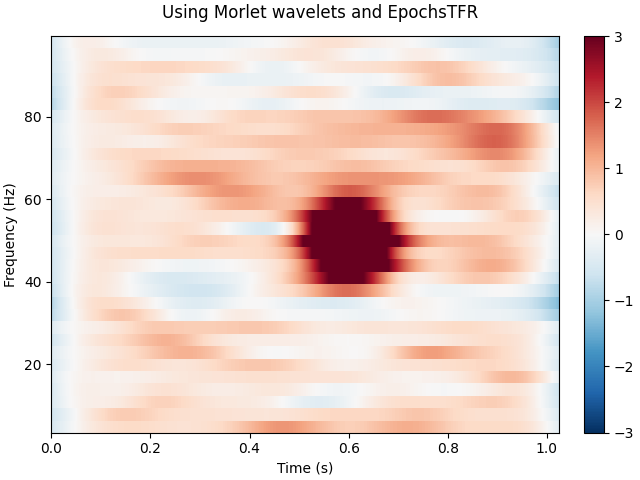
Using data from preloaded Raw for 40 events and 1025 original time points ...
<class 'mne.time_frequency.tfr.EpochsTFR'>
Applying baseline correction (mode: mean)
对数组运算#
MNE-Python 还提供直接作用于 NumPy 数组而非 MNE-Python 对象的函数:tfr_array_morlet() 与 tfr_array_multitaper()。它们要求输入形状为 (n_epochs, n_channels, n_times),返回形状为 (n_epochs, n_channels, n_freqs, n_times) 的数组(也可通过 output 参数折叠试次维度,得到平均功率或试次间相干)。
power = tfr_array_morlet(
    epochs.get_data(),
    sfreq=epochs.info["sfreq"],
    freqs=freqs,
    n_cycles=n_cycles,
    output="avg_power",
    zero_mean=False,
)
# Put it into a TFR container for easy plotting
tfr = AverageTFRArray(
    info=epochs.info, data=power, times=epochs.times, freqs=freqs, nave=len(epochs)
)
tfr.plot(
    baseline=(0.0, 0.1),
    picks=[0],
    mode="mean",
    vlim=(vmin, vmax),
    title="TFR calculated on a NumPy array",
)
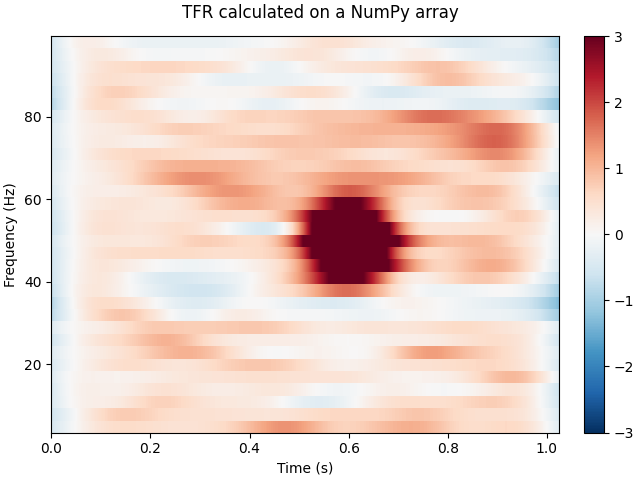
Using data from preloaded Raw for 40 events and 1025 original time points ...
Applying baseline correction (mode: mean)
脚本总运行时间:(0 分 5.217 秒)