
非官方中文翻译
本页译自 MNE-Python 官方文档:
查看英文原文 ↗。
文档版权归 MNE Developers 所有(BSD-3-Clause)。
说明
转到末尾下载完整示例代码。
使用自定义逆求解器进行源定位#
本示例的目标是展示如何在 MNE 中接入自定义逆求解器,以便与 MNE 已实现的方法(wMNE、dSPM、sLORETA、eLORETA、LCMV、DICS、(TF-)MxNE 等)进行经验比较。
本脚本用于教学,适合方法评估与新方法开发,并非分析数据的良好实践示例。
示例使用 apply_solver 与 solver 两个函数,因此只需修改 solver 函数(它只接收三个参数:白化后的数据、增益矩阵与朝向数),即可尝试其他逆算法。
# Authors: The MNE-Python contributors.
# License: BSD-3-Clause
# Copyright the MNE-Python contributors.
import numpy as np
from scipy import linalg

import mne
from mne.datasets import sample
from mne.viz import plot_sparse_source_estimates

data_path = sample.data_path()
meg_path = data_path / "MEG" / "sample"
fwd_fname = meg_path / "sample_audvis-meg-eeg-oct-6-fwd.fif"
ave_fname = meg_path / "sample_audvis-ave.fif"
cov_fname = meg_path / "sample_audvis-shrunk-cov.fif"
subjects_dir = data_path / "subjects"
condition = "Left Auditory"

# Read noise covariance matrix
noise_cov = mne.read_cov(cov_fname)
# Handling average file
evoked = mne.read_evokeds(ave_fname, condition=condition, baseline=(None, 0))
evoked.crop(tmin=0.04, tmax=0.18)

evoked = evoked.pick(picks="meg", exclude="bads")
# Handling forward solution
forward = mne.read_forward_solution(fwd_fname)
    365 x 365 full covariance (kind = 1) found.
    Read a total of 4 projection items:
        PCA-v1 (1 x 10²) active
        PCA-v2 (1 x 10²) active
        PCA-v3 (1 x 10²) active
        Average EEG reference (1 x 59) active
Reading /home/circleci/mne_data/MNE-sample-data/MEG/sample/sample_audvis-ave.fif ...
    Read a total of 4 projection items:
        PCA-v1 (1 x 10²) active
        PCA-v2 (1 x 10²) active
        PCA-v3 (1 x 10²) active
        Average EEG reference (1 x 60) active
    Found the data of interest:
        t =    -199.80 ...     499.49 ms (Left Auditory)
        0 CTF compensation matrices available
        nave = 55 - aspect type = 100
Projections have already been applied. Setting proj attribute to True.
Applying baseline correction (mode: mean)
Reading forward solution from /home/circleci/mne_data/MNE-sample-data/MEG/sample/sample_audvis-meg-eeg-oct-6-fwd.fif...
    Reading a source space...
    Computing patch statistics...
    Patch information added...
    Distance information added...
    [done]
    Reading a source space...
    Computing patch statistics...
    Patch information added...
    Distance information added...
    [done]
    2 source spaces read
    Desired named matrix (kind = 3523 (FIFF_MNE_FORWARD_SOLUTION_GRAD)) not available
    Read MEG forward solution (7498 sources, 306 channels, free orientations)
    Desired named matrix (kind = 3523 (FIFF_MNE_FORWARD_SOLUTION_GRAD)) not available
    Read EEG forward solution (7498 sources, 60 channels, free orientations)
    Forward solutions combined: MEG, EEG
    Source spaces transformed to the forward solution coordinate frame
运行求解器的辅助函数
def apply_solver(solver, evoked, forward, noise_cov, loose=0.2, depth=0.8):
    """Call a custom solver on evoked data.

    This function does all the necessary computation:

    - to select the channels in the forward given the available ones in
      the data
    - to take into account the noise covariance and do the spatial whitening
    - to apply loose orientation constraint as MNE solvers
    - to apply a weigthing of the columns of the forward operator as in the
      weighted Minimum Norm formulation in order to limit the problem
      of depth bias.

    Parameters
    ----------
    solver : callable
        The solver takes 3 parameters: data M, gain matrix G, number of
        dipoles orientations per location (1 or 3). A solver shall return
        2 variables: X which contains the time series of the active dipoles
        and an active set which is a boolean mask to specify what dipoles are
        present in X.
    evoked : instance of mne.Evoked
        The evoked data
    forward : instance of Forward
        The forward solution.
    noise_cov : instance of Covariance
        The noise covariance.
    loose : float in [0, 1] | 'auto'
        Value that weights the source variances of the dipole components
        that are parallel (tangential) to the cortical surface. If loose
        is 0 then the solution is computed with fixed orientation.
        If loose is 1, it corresponds to free orientations.
        The default value ('auto') is set to 0.2 for surface-oriented source
        space and set to 1.0 for volumic or discrete source space.
    depth : None | float in [0, 1]
        Depth weighting coefficients. If None, no depth weighting is performed.

    Returns
    -------
    stc : instance of SourceEstimate
        The source estimates.
    """
    # Import the necessary private functions
    from mne.inverse_sparse.mxne_inverse import (
        _make_sparse_stc,
        _prepare_gain,
        _reapply_source_weighting,
        is_fixed_orient,
    )

    all_ch_names = evoked.ch_names

    # Handle depth weighting and whitening (here is no weights)
    forward, gain, gain_info, whitener, source_weighting, mask = _prepare_gain(
        forward,
        evoked.info,
        noise_cov,
        pca=False,
        depth=depth,
        loose=loose,
        weights=None,
        weights_min=None,
        rank=None,
    )

    # Select channels of interest
    sel = [all_ch_names.index(name) for name in gain_info["ch_names"]]
    M = evoked.data[sel]

    # Whiten data
    M = np.dot(whitener, M)

    n_orient = 1 if is_fixed_orient(forward) else 3
    X, active_set = solver(M, gain, n_orient)
    X = _reapply_source_weighting(X, source_weighting, active_set)

    stc = _make_sparse_stc(
        X, active_set, forward, tmin=evoked.times[0], tstep=1.0 / evoked.info["sfreq"]
    )

    return stc
定义你的求解器
def solver(M, G, n_orient):
    """Run L2 penalized regression and keep 10 strongest locations.

    Parameters
    ----------
    M : array, shape (n_channels, n_times)
        The whitened data.
    G : array, shape (n_channels, n_dipoles)
        The gain matrix a.k.a. the forward operator. The number of locations
        is n_dipoles / n_orient. n_orient will be 1 for a fixed orientation
        constraint or 3 when using a free orientation model.
    n_orient : int
        Can be 1 or 3 depending if one works with fixed or free orientations.
        If n_orient is 3, then ``G[:, 2::3]`` corresponds to the dipoles that
        are normal to the cortex.

    Returns
    -------
    X : array, (n_active_dipoles, n_times)
        The time series of the dipoles in the active set.
    active_set : array (n_dipoles)
        Array of bool. Entry j is True if dipole j is in the active set.
        We have ``X_full[active_set] == X`` where X_full is the full X matrix
        such that ``M = G X_full``.
    """
    inner = np.dot(G, G.T)
    trace = np.trace(inner)
    K = linalg.solve(inner + 4e-6 * trace * np.eye(G.shape[0]), G).T
    K /= np.linalg.norm(K, axis=1)[:, None]
    X = np.dot(K, M)

    indices = np.argsort(np.sum(X**2, axis=1))[-10:]
    active_set = np.zeros(G.shape[1], dtype=bool)
    for idx in indices:
        idx -= idx % n_orient
        active_set[idx : idx + n_orient] = True
    X = X[active_set]
    return X, active_set
应用自定义求解器
info["bads"] and noise_cov["bads"] do not match, excluding bad channels from both
Computing inverse operator with 305 channels.
    305 out of 366 channels remain after picking
Selected 305 channels
Whitening the forward solution.
    Created an SSP operator (subspace dimension = 3)
Computing rank from covariance with rank=None
    Using tolerance 3.5e-13 (2.2e-16 eps * 305 dim * 5.2  max singular value)
    Estimated rank (mag + grad): 302
    MEG: rank 302 computed from 305 data channels with 3 projectors
    Setting small MEG eigenvalues to zero (without PCA)
Creating the source covariance matrix
Adjusting source covariance matrix.
combining the current components...
以 2D 与 3D 查看(类似 3D 的“玻璃脑”图)
plot_sparse_source_estimates(forward["src"], stc, bgcolor=(1, 1, 1), opacity=0.1)
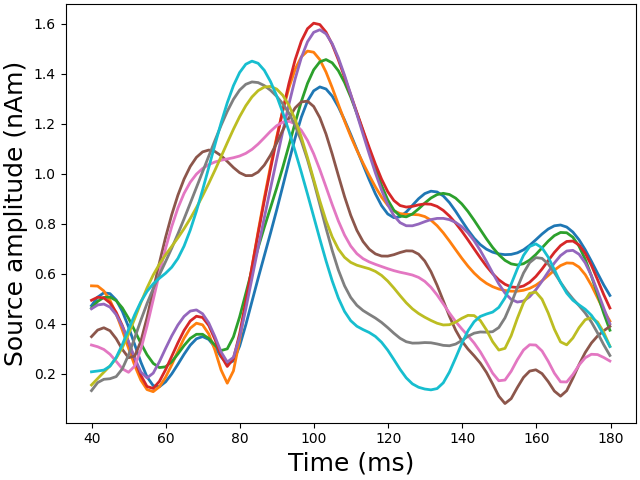
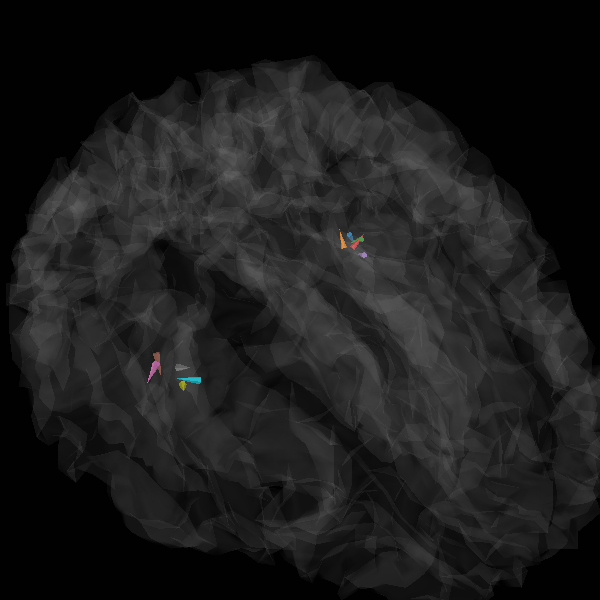
Total number of active sources: [ 56971 59453 61728 61772 68227 236975 240636 245391 250215 252407]
脚本总运行时间:(0 分 1.258 秒)